


This post is also available in:
What runs like a thread through all the reports to date is the lack of any firm evidence, as well as contradictions in the accounts offered by the only two named sources in Gavazzeni’s book to have direct knowledge of the initial wartime intelligence pointing to such a practice.
Other sources in the book describe life under siege and say they heard talk of people paying to shoot at Sarajevans, but even the two named sources have no firsthand knowledge of what went on, and, in interviews with BIRN, have expressed scepticism about some of the claims put forward by Gavazzeni.
First reported in 1995
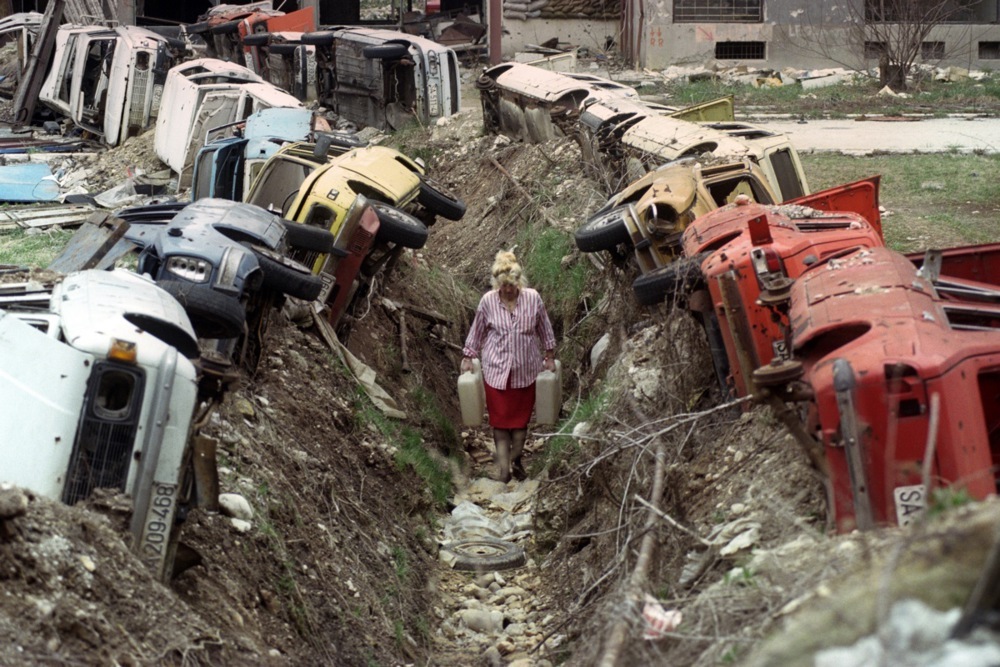
A Bosnian woman carries water along trenches formerly used as anti-sniper protection in Sarajevo, April 1996. Photo: EPA/FEHIM DEMIR.
More than 11,000 civilians died in the siege of Sarajevo, the longest in modern warfare.
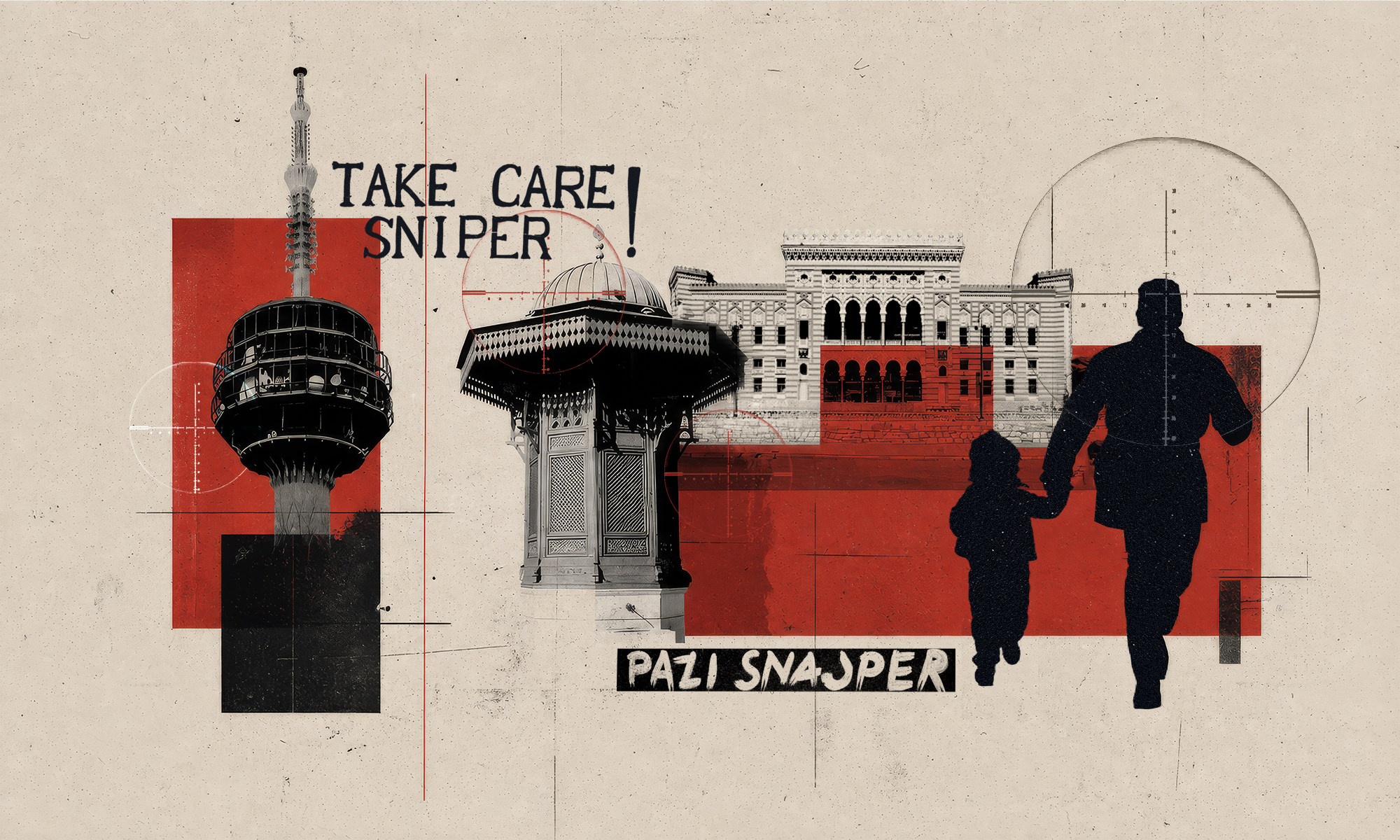
They were killed by Bosnian Serb artillery that rained down indiscriminately on the city from the hills that circle it, and by Bosnian Serb snipers who terrorised residents, forcing them to dart across streets and take cover behind the burned carcasses of cars or pockmarked walls just to go about their daily lives. One street was so dangerous it became known as Sniper Alley.
But were the Bosnian Serbs also offering up their sniper posts and rifles to paying foreigners?
That was the claim made by two refugees from Sarajevo who were among a number of witnesses before the Permanent People’s Tribunal, PPT, a human rights organisation founded in Italy and which held a session in Bern, Switzerland, in February 1995, with the wars in Croatia and Bosnia still raging.
PPT Secretary-General Gianni Tognoni told Corriere della Sera about their accounts, and the Italian newspaper ran the story under the headline: ‘Holidays in Bosnia, People-Shooting Included’. The claim did not make it into the PPT’s final report, due to a lack of evidence.
Three decades later, Tognoni told BIRN he had approached some of the witnesses after the tribunal session. “Two of them told me that there were snipers coming from all around Europe, and they mentioned that they were coming from Italy as well,” he said.
“Of course, we discussed these claims in detail, because they were serious allegations. But undertaking a specific investigation was impossible for us at the time, so we decided not to compromise the credibility of the Tribunal by writing ‘it is said that’.”
In 2022, Zupanic’s film offered up a new source: Edin Subasic, a Bosnian military intelligence analyst during the war and who later became a key source for Gavazzeni’s book.
Subasic recalled reading a report from the interrogation of a Serb volunteer fighter from Paracin, in the Great Morava river valley of central Serbia.
The phenomenon of ‘weekend warriors’ is well-known: for a daily fee, Serbs would cross into Bosnia from Serbia or Montenegro and join the killing and looting, then travel back with the spoils, all in the name of a Greater Serbia.
The volunteer from Paracin was detained by Bosnian government forces and questioned. Subasic said he read the interrogation report in late 1993. In it, the man claimed five foreigners, including three Italians, were with him on a bus heading for Bosnian Serb positions around Sarajevo. He asked them how much they were being paid.
“As I understood it, the conversation took place in rather poor English, during which they made the key statement,” Subasic told BIRN. The Italians, one of whom said he was from Milan, apparently told the man: “We pay to come here.”
According to Subasic, the then head of Bosnian military intelligence, Mustafa Hajrulahovic, personally passed the information to an officer of the Italian intelligence service, SISMI, whom Subasic described as being attached to UNPROFOR, the United Nations peacekeeping force in Bosnia at the time.
Trained in Italy and fluent in Italian, Hajrulahovic was known as ‘The Italian’. He is no longer alive.
“We had information concerning Italy and asked them to verify what we provided,” said Subasic. “If it was accurate, we asked them to tell us what it was about. If it wasn’t, we asked them to tell us that as well.”
“We could give them the time it happened, that they were from Milan, and the rest. At that point, the story effectively ended on our side.”
The Italian response came in late March or early April 1994, he said, recalling that it arrived in the wake of an agreement that halted fighting between the Bosnian army and Croat forces. The Italians claimed to have nipped the issue in the bud.
This is where discrepancies arise, however.
Memory issues?
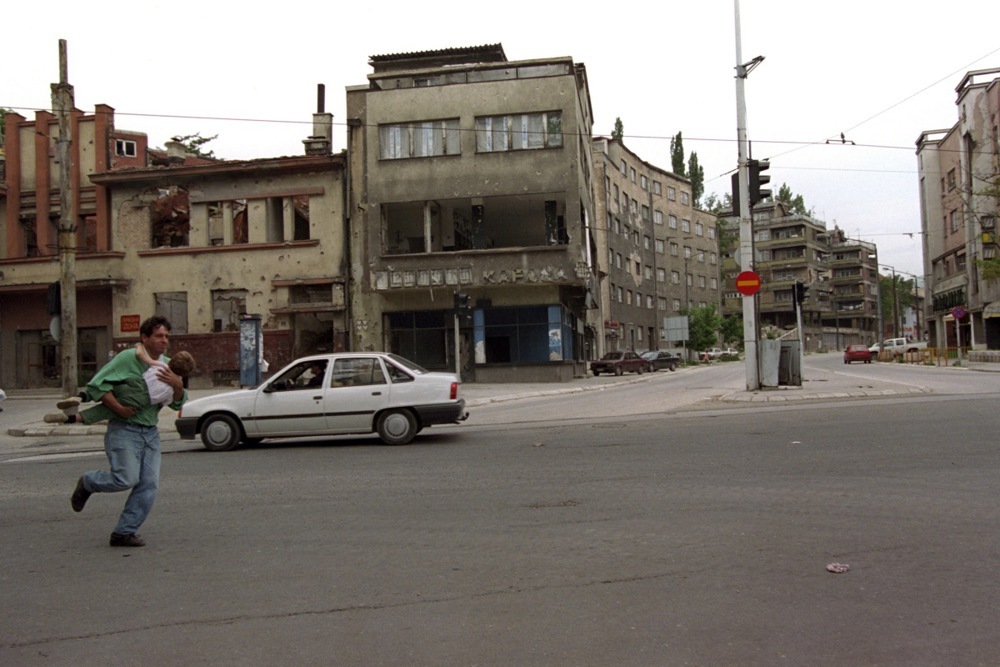
A father runs carrying his child across a deserted street in the city centre as sniper fire breaks out in Sarajevo, June 1995. Photo: EPA/ENRIC MARTI..
Michael Giffoni says he heard about the exchange of information between Bosnian intelligence and the SISMI shortly after his arrival in Sarajevo on October 25, 1994, as the 29-year-old deputy head of the Italian Special Diplomatic Delegation.
The SISMI agents, he said, were officially registered as security officers for the delegation, not part of UNPROFOR.
Giffoni quoted the agents as telling him about the claims made by the Serb volunteer fighter from Paracin, passed to them by Bosnian intelligence. But Giffoni says the information exchange took place after the Italian Special Diplomatic Delegation was set up in April 1994, much later than Subasic claimed, and said it in no way involved UNPROFOR. Italy, as a neighbour of Yugoslavia and a former fascist occupier of parts of the Balkans during World War Two, was not part of UNPROFOR.
“There were civilians, officials,” said Giffoni. “But none of them were linked to SISMI. I can rule that out,” he told BIRN. “This is something that needs to be corrected, because it is not true.”
Giffoni is quoted in Gavazzeni’s book from other sources, but the author never actually interviewed him.
Andrea Angeli, a UN press officer in Sarajevo in 1993-1994, said UNPROFOR contained no Italian police or military personnel, something the Italian government also confirmed at the time.
“If Mr. Subasic wanted to talk to the SISMI, he could have done so directly,” he said. “I don’t understand why he brought up the UN mission.” Angeli said that, until 1994, he himself, a civilian, was the only Italian in UNPROFOR and that he personally was never in touch with either Subasic or Hajrulahovic.
Gavazzeni’s book relies heavily on unnamed sources. Among those offering any substantial information regarding the alleged ‘safari’ phenomenon, only Subasic and Giffoni are quoted on record. Of the two, only Subasic was actually interviewed by Gavazzeni. Their accounts form much of the foundation of his book. Gavazzeni told BIRN that Giffoni was present during the meeting when the Bosnians handed over the intelligence, a meeting the author told BIRN happened “at the end of ‘93”.
Giffoni disputed this, telling BIRN: “In ‘93, I was dealing with Bosnia but from Rome; I arrived in Sarajevo in October ‘94.” He said he only heard about the intel from the SISMI agents.
Asked about the discrepancies in their accounts, Gavazzeni said Subasic may have been confused about the involvement of UNPROFOR, perhaps mistaking Giffoni as being affiliated with the peacekeeping force. “In all likelihood, Michael Giffoni slept, ate, and lodged in those [UNPROFOR] premises,” Gavazzeni told BIRN.
Besides denying being present at the meeting, Giffoni also told BIRN he only ever visited UNPROFOR facilities for meetings and press conferences.
In a later conversation with BIRN, Gavazzeni conceded Giffoni could not have been present at the meeting, but offered another explanation: that the SISMI officers contacted by Bosnian military intelligence were already on the ground before Italy opened its Special Diplomatic Delegation. The contradictions in Giffoni’s and Subasic’s accounts are “issues related to memory”, he told BIRN, though he conceded he hadn’t cross-checked Subasic’s account with that provided by Giffoni in other media and mentioned in his book.
On the eve of publication of this article, Gavazzeni sent BIRN links to four PDF files totalling 1,257 pages, saying they contained evidence that “SISMI was present in Sarajevo since 1993, lodged at UNPROFOR”. Subasic had sent BIRN the same documents several hours earlier. However, a search in the files for the acronym ‘SISMI’ produced zero results. ‘UNPROFOR’ appears a few times, but not in relation to SISMI activities.
Whether SISMI agents were present in Sarajevo in 1993, officially or not, could not be definitively established. However, the disagreement over the issue highlights differences between key accounts of what happened – recollections that formed the basis for the book that sparked the international media frenzy about the ‘sniper safaris’.
Giffoni says that when SISMI did receive the information about the foreign snipers from Bosnian intelligence, the Italian agency’s response was brief: “The report was taken into account, it was investigated and the traffic was blocked.”
That’s what he says he was told in 1994 by the two SISMI agents stationed at Italy’s Special Diplomatic Delegation. In 1995, after Oslobodjenje in Bosnia picked up the original Corriere della Sera story, Giffoni says he asked Hajrulahovic directly. Hajrulahovic, he said, confirmed giving the intel to SISMI and said he was told “traffic had been stopped”.
What exactly was meant by ‘traffic’ remains unclear, however: the flow of paying foreigners or paid weekend warriors, or something else completely?
According to Giffoni, even the SISMI agents in Sarajevo didn’t know what steps had been taken in Italy, though he remains sure that Italian authorities intervened in some form. Giffoni said that everything he found out was from conversations he had; he saw nothing committed to paper. Giffoni remained in the Italian diplomatic service until 2014, when he was charged with and later acquitted of criminal conspiracy and aiding and abetting illegal immigration stemming from allegations of fake visas being issued by the Italian embassy in Kosovo at the time he was ambassador. He never returned to the diplomatic service.
Gavazzeni told BIRN he has two new sources who, he said, testified to Italian prosecutors in June this year. These sources, he said, claim to have received documents in the spring or summer of 1994 containing the names of five Italians suspected of paying to shoot on Sarajevo. He did not provide any further information to BIRN about the sources.
Numbers disputed
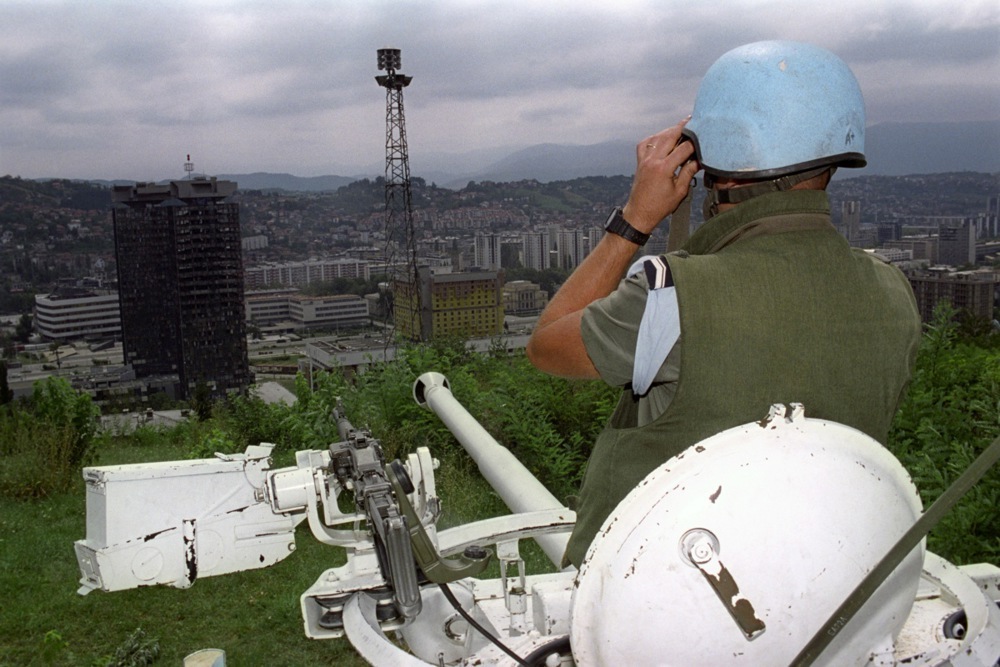
A UNPROFOR soldier scans the Sarajevo hills for snipers from atop a UN vehicle during the siege of Sarajevo, August 1994. Photo: EPA/FEHIM DEMIR.
Giffoni, who has testified before prosecutors in Milan, doesn’t dispute that foreigners were paying for the chance to shoot at innocent civilians in Sarajevo, but does question the scale depicted in Gavazzeni’s book given the difficulty of accessing such positions around Sarajevo.
“The numbers are completely crazy,” he said. “I think this thing existed […] but we’re talking about a dozen or so people at most.”
Subasic also doubts there were as many as Gavazzeni claims.
“It seems to me somewhat excessive that there was such a level of circulation,” he told BIRN.
“If there had been that much movement, there would be more witnesses to their arrivals and departures. That also suggests to me that there were not many of them.”
That said, Subasic conceded that such a phenomenon would have been “well protected by counterintelligence measures”.
He also expressed scepticism about some of the more morbid details in Gavazzeni’s book.
“There was supposedly a price list for the safari,” he said. “A different price for a child, a woman, a pregnant woman, an adult, an elderly person, a civilian or a soldier in uniform seen in the city – as if each of these had its own tariff.”
“That kind of morbid and bizarre detail, no matter how much money is involved, is still horrific.”
Giffoni also expressed doubt about a ‘price list’.
“Frankly, the idea that they had set up a dedicated and detailed price list on who the victims should be seems to me hardly plausible, if not completely implausible, also because [shooters] had their minutes numbered, that is, [they] shot at anyone who passed by,” he said.
Confronted by the doubts expressed by two key sources in his book, Gavazzeni told BIRN: “I only say what my sources tell me.”
“The sources were verified by other sources, that I can say, but I cannot swear on the Bible that 230 is the exact number of Italians and that a similar number came from other Western countries. That is only my sources’ testimonies.”
He said that 70 per cent of sources cited in his book also testified to Italian prosecutors.
Asked how readers could trust in the veracity of the many anonymous sources quoted in his book, given his failure to reconcile the differences in Giffoni’s and Subasic’s accounts, Gavazzeni said: “We did everything possible, I assure you.”
No material evidence
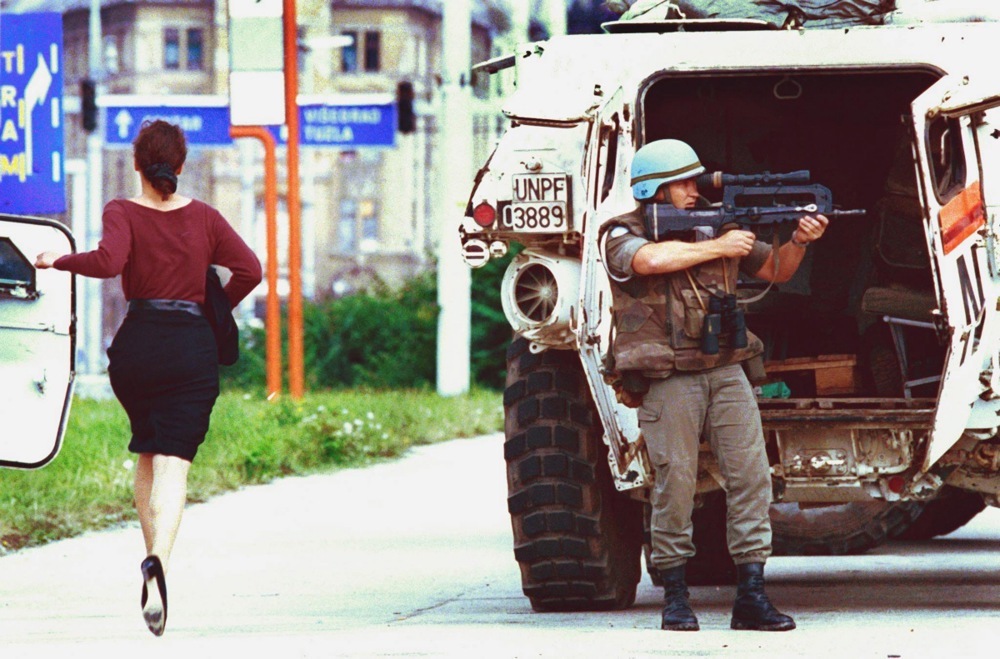
A UN soldier provides cover for a civilian woman running along “Sniper Alley,” August 4, 1994. Photo: EPA/CHRIS PFUHL
Zupanic’s documentary cites another source, an undercover agent of a ‘foreign service’ who, according to the film, infiltrated Bosnian Serb positions above Sarajevo on the pretence of being a reporter.
BIRN managed to identify the source. He responded via the production company behind Zupanic’s film, Arsmedia, and agreed to speak on condition of anonymity.
He spoke by phone from Slovenia, a former Yugoslav republic. He described himself as a former Yugoslav intelligence officer who went by the codename ‘Piskotek’, Slovenian for ‘cookie’. Four other sources confirmed his identity.
Piskotek recalled attending a press conference in the Bosnian Serb military stronghold of Pale, “after which one of the soldiers asked me if I could stay overnight to see something interesting”.
He said he was taken by Bosnian Serb forces to a position above Sarajevo, where he saw a man who had a foreign passport in his front pocket and was conversing with the soldiers in English.
“I knew he was a foreigner, and they were preparing the sniper rifles for him to shoot,” Piskotek said. He claimed to have seen nine foreigners shooting in total, all dressed in hunting gear and firing weapons.
After Sarajevo Safari was aired, the city’s mayor at the time, Benjamina Karic, filed a complaint to the Bosnian public prosecution. The investigation has produced no results so far.
Probes are ongoing in Milan – based on a complaint filed by Gavazzeni before his book came out – as well as in Austria and Belgium. In the Milan investigation, at least, there is currently no material evidence to support the claims.
Marko Lugonja, who headed the Security Department of the Sarajevo-Romanija Corps of the Bosnian Serb Army, categorically rejected the allegations, saying he would have known had it been happening.
“It has no basis in fact,” Lugonja told BIRN. “But once something like that is pushed through the media, it takes a long time for a person to clear their name.”
“There were a few volunteer fighters from Ukraine and Russia,” he said. “But for something like this to have happened – no chance.”
“No one is more competent than I am to know whether something like this existed.”
On the other side, Sefer Halilovic, the former Chief of the General Staff of the Army of Bosnia and Herzegovina, denied ever receiving any intelligence concerning such a phenomenon.
“I had no information from the Military Security Service or the Intelligence Service,” he said. “What they are talking about, they are mostly inventing. They knew nothing. They are lying.”
Former CIA officer Douglas H. Wise, who served as Deputy Director of the US Defence Intelligence Agency in 2014-2016 and was stationed in Sarajevo during the war, said he never heard even once about foreigners paying to shoot on Sarajevo.
Declassified CIA documents on the war also make no mention of anything similar happening.
“Examine the logistics: getting a wealthy Westerner within 200 metres of Sniper Alley means transport, security, and silence from everyone on the Serb side and everyone in the visitor’s own entourage,” Wise wrote in response to BIRN.
“That’s not a conspiracy that survives contact with operational reality. What’s far more plausible is something more mundane – a politically connected Serb or a visitor at the front line, handed a look through a scope out of bravado. Even that’s a stretch. And if it happened, the Serb disinformation apparatus would have every incentive to point the finger at rich Westerners rather than their own.”
‘Hard to imagine’
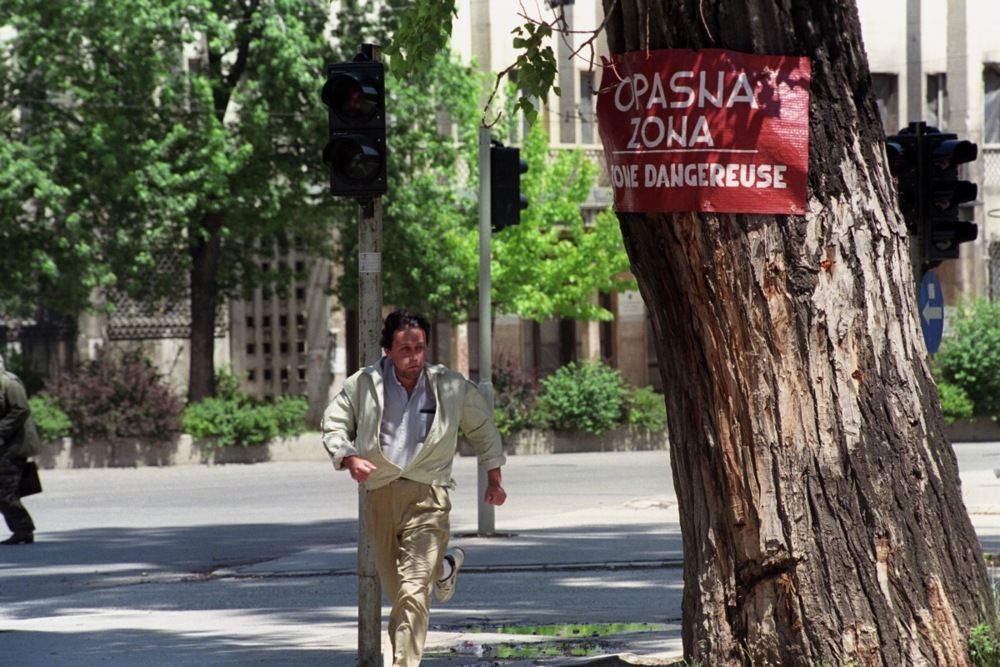
A UN soldier provides cover for a civilian woman running along “Sniper Alley,” August 4, 1994. Photo: EPA/CHRIS PFUHL
In the archives of seven cases involving the siege of Sarajevo and conducted at the International Criminal Tribunal for the former Yugoslavia, ICTY, in The Hague, there are only two mentions of anything like a ‘safari’ – during the trials of Dragomir Milosevic, commander of the Sarajevo-Romania Corps of the Bosnian Serb army, and former Serbian strongman Slobodan Milosevic.
In the latter, protected witness C-017 referred to Nicholas Ribic, a Canadian national of Serb origin convicted in Canada of hostage-taking in another country, and said he had come to Bosnia on “safari, to hunt people”.
In the Dragomir Milosevic trial, former US marine John Jordan, who volunteered as a firefighter in besieged Sarajevo, recalled seeing men in Bosnian Serb positions who “did not look like ordinary army”.
Jordan said they were dressed more in hunting gear than military fatigues and that he assumed they were foreigners. They carried what looked like hunting rifles but he never saw any of them shooting.
After watching Sarajevo Safari, Jovana Kolaric, a researcher at the Belgrade-based Humanitarian Law Centre who has looked in depth at the involvement of foreign fighters, also trawled the ICTY archives.
“I didn’t find anything except the testimony of John Jordan and this Canadian guy, Nicolas Ribic. But he’s not a tourist,” Kolaric told BIRN, meaning Ribic was a volunteer fighter from abroad, not someone paying to take part.
Angeli, the former UN press officer, said he has another reason for doubting the story of a ‘Sarajevo safari’. At the time, Sarajevo was host to some of the most tenacious journalists of their time, yet none of them broke the story or pursued it following the Corriere della Sera text of March 1995.
“Bear in mind that the world’s most prestigious journalists were stationed nonstop in Sarajevo,” he said.
“It’s hard to imagine that such a serious piece of news escaped their notice, much less that they didn’t pursue it properly when the first leaks surfaced in the press during the final phase of the war, in the spring of ‘95.”
Gavazzeni said he had been criticised by some of those journalists who were based in Sarajevo or passed through during the war.
“You see this is the logic: ‘I didn’t know it, and since I didn’t know it, it never happened,’” he told BIRN. “But to me it really seems like a stretch. Actually it seems like sour grapes, forgive my bluntness, but there are a lot of people who are bitter about this.”
According to Kolaric, part of the problem is a general confusion between the issue of volunteer fighters, mainly Serbs from outside Bosnia as well as some Russians and other mercenaries, and foreigners who allegedly paid for the apparent thrill of killing.
“In the former Yugoslavia, there were a ton of foreign fighters in every single army in the conflict,” she said. “Those people aren’t those safari tourists. There is a lot of confusion and a lot of noise without any facts, actually.”
What is so disappointing, she added, is that not a single Bosnian Serb sniper has ever been prosecuted for terrorising Sarajevo.
“We have the documents, we have the direct orders from the Bosnian Serb Army that every unit needed to have a specific number of snipers,” Kolaric told BIRN.
Instead, she said, “we have the whole moral panic about this story, but [we] don’t talk about the victims, we don’t talk about responsibility.”
“We talk about a few incidents that we can’t confirm yet.”