


This post is also available in:
In a photograph taken in besieged Srebrenica during the Bosnian war but before the 1995 genocide, several people are sitting at a dining table having lunch.
It shows Nirha Efendic, her parents, her brother and doctors from the international volunteer organisation Medecins Sans Frontieres (Doctors Without Borders), MSF.
No one would guess that a war was ongoing, or that this photo was taken in a town in eastern Bosnia where violence, hunger and insecurity defined everyday life.
Two of the people in the picture, her father Hamed and her brother Fejzo, were subsequently killed during the genocide carried out by Bosnian Serb forces, which is commemorated each year on July 11.
For Efendic, photographs like this – the last ones showing her family together – are not just memories; they are reminders of a time when people tried to preserve a sense of normality.
Efendic says that during the war, her mother wanted her and her brother to have contact with people coming from outside the enclave, so they could practice their English and have a “window to the world” and events beyond it.
Medics from MSF often came for lunch, prepared by her mother using whatever ingredients were available. Her mother’s culinary creativity brought modest but tasty meals to the table, but the lunches were about much more than food.
“When we invited those doctors to lunch, we wanted, within our very limited means, to show them they were welcome and to express our gratitude and recognition for being there with us, sharing our suffering – even though they had homes far away and could leave whenever they wished,” Efendic recalls.
“Perhaps we envied that a little, but it meant a great deal to us that they were there, giving us hope that everything would one day pass, that we were not alone,” she adds.
The family photograph is one of 12,000 images collected so far by Srebrenica Memorial Centre and the University of Amsterdam for a project called “Facing Srebrenica”, which will be launched with an exhibition at the Memorial Centre to coincide with the annual genocide commemorations.
The organisers solicited photographs from former members of Dutchbat, the Dutch Battalion of UN peacekeepers who were stationed in Potocari, near Srebrenica, in July 1995, when the genocide happened.
Azir Osmanovic, head of the archival team at the Srebrenica Memorial Centre, says the project has helped to reconnect wartime friends – Dutch soldiers and people who lived in Srebrenica – and has also brought joy to families who did not have a single photograph of their loved ones.
“Facing Srebrenica” aims to tell the stories of the children who survived the genocide and became successful people, as well as those who never had the chance, Osmanovic explains.
“We tried to select children from different parts of Srebrenica and its surroundings, to present different stories, to show that today, from those photographs, we have very successful individuals – people who were educated, who became PhDs or professors,” he says.
“We also see how some children who were very young at the time had health problems, and how Dutchbat soldiers tried to help them – today, they are alive and living their lives.”
Interrupted childhood
Efendic remembers life before the war as a home full of guests, parents who worked hard to provide a carefree childhood and family trips to the seaside.
“That was life. People gave a lot to others and to their neighbours, and there was no anxiety – no anxiety in the soul,” she recalls with a smile.
Her happy childhood, like that of thousands of other children in Bosnia and Herzegovina, was interrupted by the war in the 1990s. She was only 13 when it started, in 1992, but could clearly see the worry on the faces of her father and mother.
“The first year of the war was terrible. We didn’t go to school. We were isolated. Food was becoming scarce, uncertainty was growing. Winters were harsher. Shells fell relentlessly. Hunger and deprivation. A lack of everything that a normal life entails,” she says.
Temporary respite came when the UN declared Srebrenica a demilitarised zone, allowing children to return to school.
During these first years of the war, her greatest support was her brother Fejzo, four years older, a gifted student who won numerous awards in mathematics and physics.
BIRN spoke with Efendic at the National Museum of Bosnia and Herzegovina in Sarajevo, where she works as a curator of oral literature and a senior research associate.
She has studied a large collection of oral poetry consisting of several thousand recorded songs.
“What I noticed is that among those thousands of songs, there is not a single one that records revenge or negative feelings of a sister toward a brother,” she observes.
“There are many ballads about dramatic conflicts – between brothers, between father and son, even between mother and son – but a sister never raised her hand against a brother. There is no stronger love, when it comes to family bonds, than the love of a sister for a brother,” she reflects.
She last saw her brother and father in July 1995. She remembers days of constant shelling. She left with her mother for the UN base in Potocari, saying goodbye to her father at the front door.
“He held me in his arms for a long time. I heard his heartbeat, and I still hear it today. Then I left. Then I came back – I don’t know why, probably to see him again – and I saw him. He just said to me: ‘Go, keep going,’” she recalls through tears.
She saw her brother for the last time moments later, on a bridge. Their mother begged him to come with them, but he chose to stay with their father.
After spending several days in the battery factory in Potocari – which today is the site of the Srebrenica Memorial Centre – she and her mother climbed onto a truck and left Srebrenica.
“I remember the heat of that July day and the intense light, and I remember my fever despite it. I felt very cold, even though the temperature must have been close to 40 degrees,” she says.
Healing more important than revenge
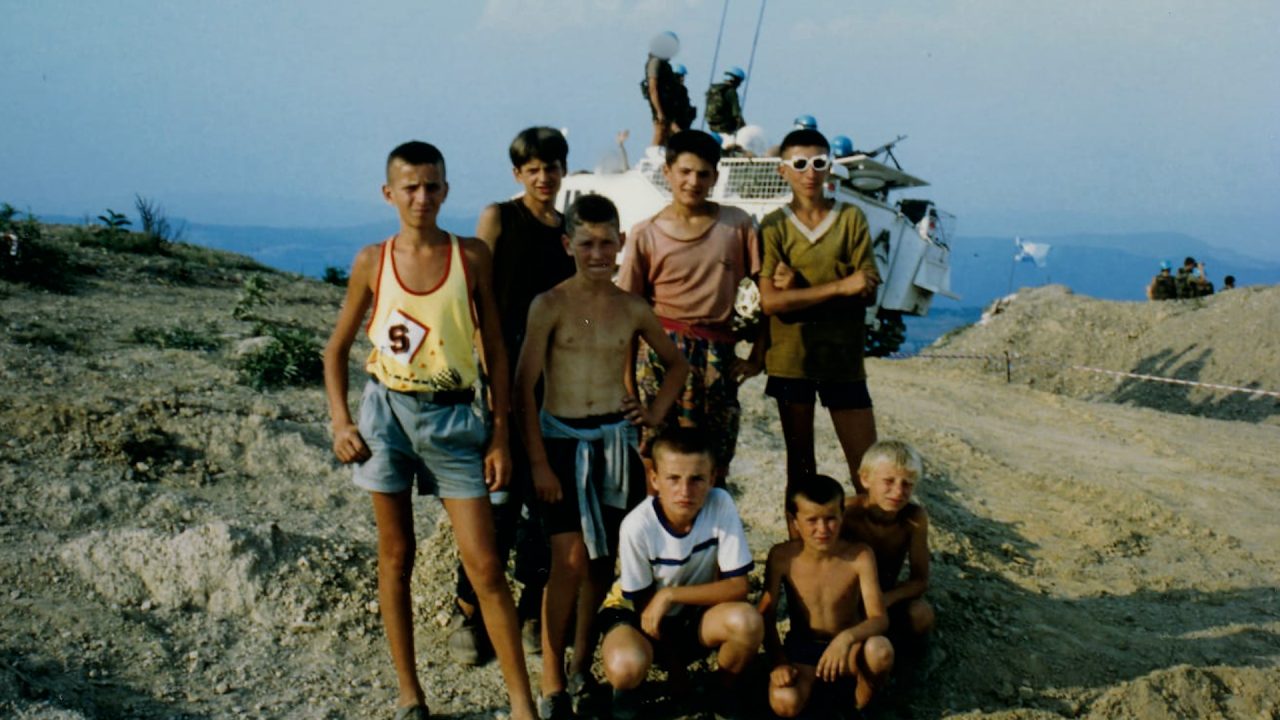
Children in Srebrenica during the war. Photo: Memorial centar Srebrenica and University in Amsterdam
Efendic received various pieces of information about the fate of her loved ones. According to some sources, her father was killed in Kravica; according to others, in Bratunac. Her brother Fejzo, she later learned, was killed in Branjevo.
Her father was found in a secondary mass grave in Zeleni Jadar and buried at the first annual collective funeral of Srebrenica victims, while Fejzo’s remains were buried ten years later. To this day, not all victims of the genocide have been found and buried.
For Efendic, visiting the cemetery at the Memorial Centre represents a meeting with them and an opportunity for conversation.
“I feel a kind of relaxation of the soul because we need that place of encounter – not only a place of mourning, but of reassembling the soul. Just as the body needs to be made whole, the soul also needs to be made whole, because pieces of it have gone everywhere,” she says.
“Here they come together again like a mosaic, at least to some extent, and we experience a small step of healing,” she says.
After leaving Srebrenica, a new struggle began for Efendic and her mother Fadila. Her mother went to Germany, while Efendic insisted on staying in Zagreb in Croatia to continue her education at what is now the Islamic Gymnasium.
“I wouldn’t have asked my mother to let me stay if, in those few days, I hadn’t experienced my first beautiful moments that helped heal my soul – that was encountering the recitation of the Koran with the hafizes who were there,” she says, adding that she was not even aware at the time how important that decision was.
After finishing high school, Efendic returned to Bosnia and Herzegovina with her mother, graduated from the Faculty of Philosophy in Sarajevo, and later completed her master’s and doctoral studies.
There was one more obligation – to find a way to tell her own story. That is how her book Kopča (“The Clasp”) came about – not as a call for revenge but as an attempt to tell her pain in a way that could heal others.
“By writing it, I was healing my own wounds, and I wanted others who had gone through similar experiences, by reading my text, to heal alongside me – to try to come out stronger: to say what needed to be said, but in the most beautiful possible way – not as a call for revenge, but as a call for love. Love for people, for God’s creation,” she says.
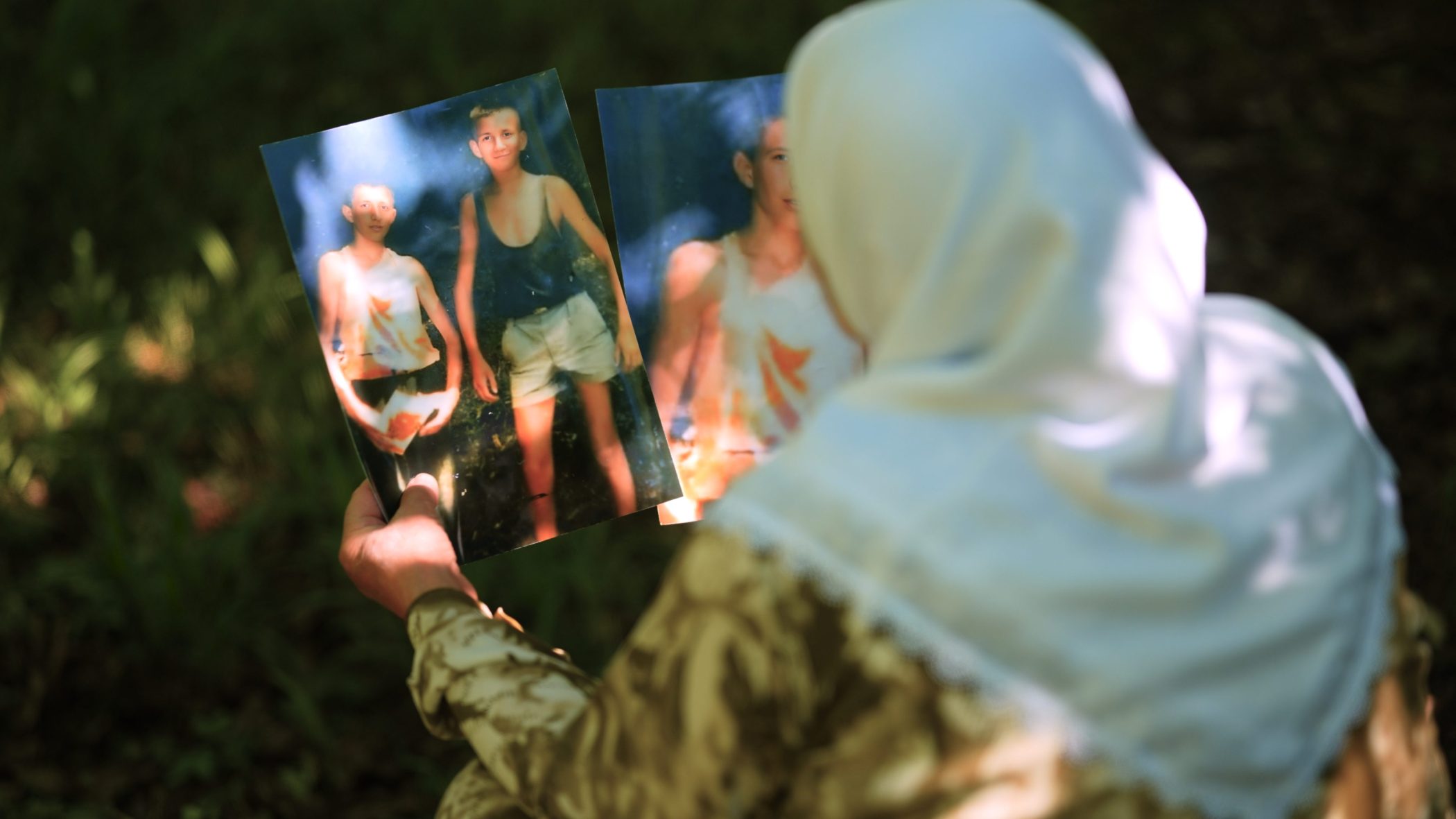
More than 30 years after the genocide in which more than 7,000 men and boys were killed by Bosnian Serb forces, Efendic and her mother sit in their family home in Potocari, looking at family photographs. In the pictures are the smiling faces of those who are no longer with them.
Despite all the losses inflicted by the war and the genocide, Efendic says he has tried to be better than those who harmed her brother and father, whose expression the last time she saw him still remains with her.
“That look of his, that ‘Keep going’ look, has followed me to this day. Life is full of different trials; it’s multi-layered. When you think you have won all battles or lost them all – that’s not true, you don’t know. But to keep going is what you can and must do,” she says.
She followed his advice then, and still does now: “I left. I moved forward. I’m still doing that.”