




This post is also available in:
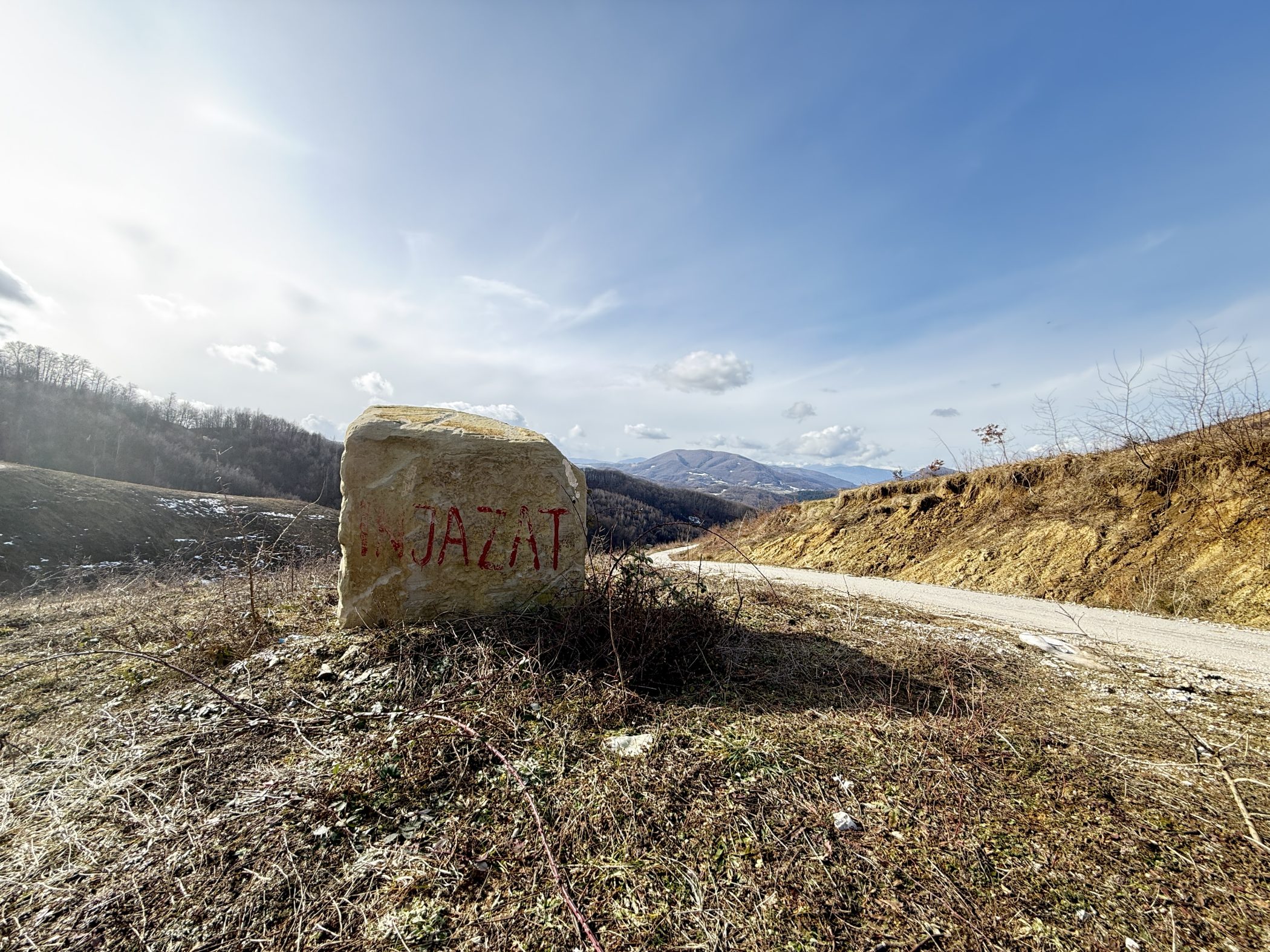
Young plants sprout from a barren landscape near the village of Dobro, 25 miles north east of Sarajevo in Bosnia and Herzegovina’s Visoko region. On the bare land sits a huge stone with the inscription ‘Injazat’.
Three years ago, at this site, excavators were filmed for a promotional video as they cleared 18 hectares – equivalent to 25 football pitches – of forest. The cleared land was divided into plots, seemingly ready for sale. The video was filmed for Kuwaiti-owned company Poduhvati Buducnosti – Injazat Future (PB-IF), which had purchased the land as part of 60 hectares of land it bought in the Visoko region.
Yet nothing has been built on this stretch of now bare land near Dobro. According to local planning laws, construction is prohibited in much of this area, which sits in a protected water source zone and is deemed agricultural or forest land. An investigation by Detektor and the Arab Reporters Network has revealed that Dobro is no one-off. Injazat Future and a string of related companies including PB-IF, are cutting down forests in Bosnia and Herzegovina in order to sell land to foreign investors who are often unable to build there.
Indictments
Injazat Future, which promotes itself as specialising in real estate, sells rural plots to investors from the Gulf, mainly targeting middle-income buyers at prices starting from 18,000 marks (around $10,500) per 500-1000 square metres. The firm, owned by Nayef Abu Shaibah, operates in Bosnia and Herzegovina through several other companies, including Senyar, PB-IF, Deema and one named after himself, Nayef Abu Shaibah. All are run by Abu Shaibah who has opened multiple branches of his companies in the country over the past 14 years.
Once cleared of trees and portioned into lots, the land is then offered to buyers at significantly marked-up prices. With idyllic scenes on Injazat Future’s Instagram feed of land in the middle of Bosnian nature, the firm has been attracting buyers from around the Gulf by convincing them they are allowed to build houses on the land, even though often permits have not been secured.
Prosecutors suspect forests in Visoko have been illegally cleared by Injazat Future and individuals connected to the company. In July 2025 and February 2026 the regional Prosecutor’s Office of the Zenika-Doboj canton filed two indictments for the criminal offence of forest devastation against the firm and individuals connected to the company.
February’s indictment, involving the land just outside Dobro, alleges tree cutting was carried out by PB-IF on an area equivalent to 25 football fields, causing an estimated 150 thousand marks (around $90,000) of damage to the forest and local biodiversity. The previous indictment alleges Injazat Future cut down a forest in the municipality of Visoko causing a barren area the size of five and a half football fields, causing 31 thousand marks (around $19,000). These proceedings are still ongoing.
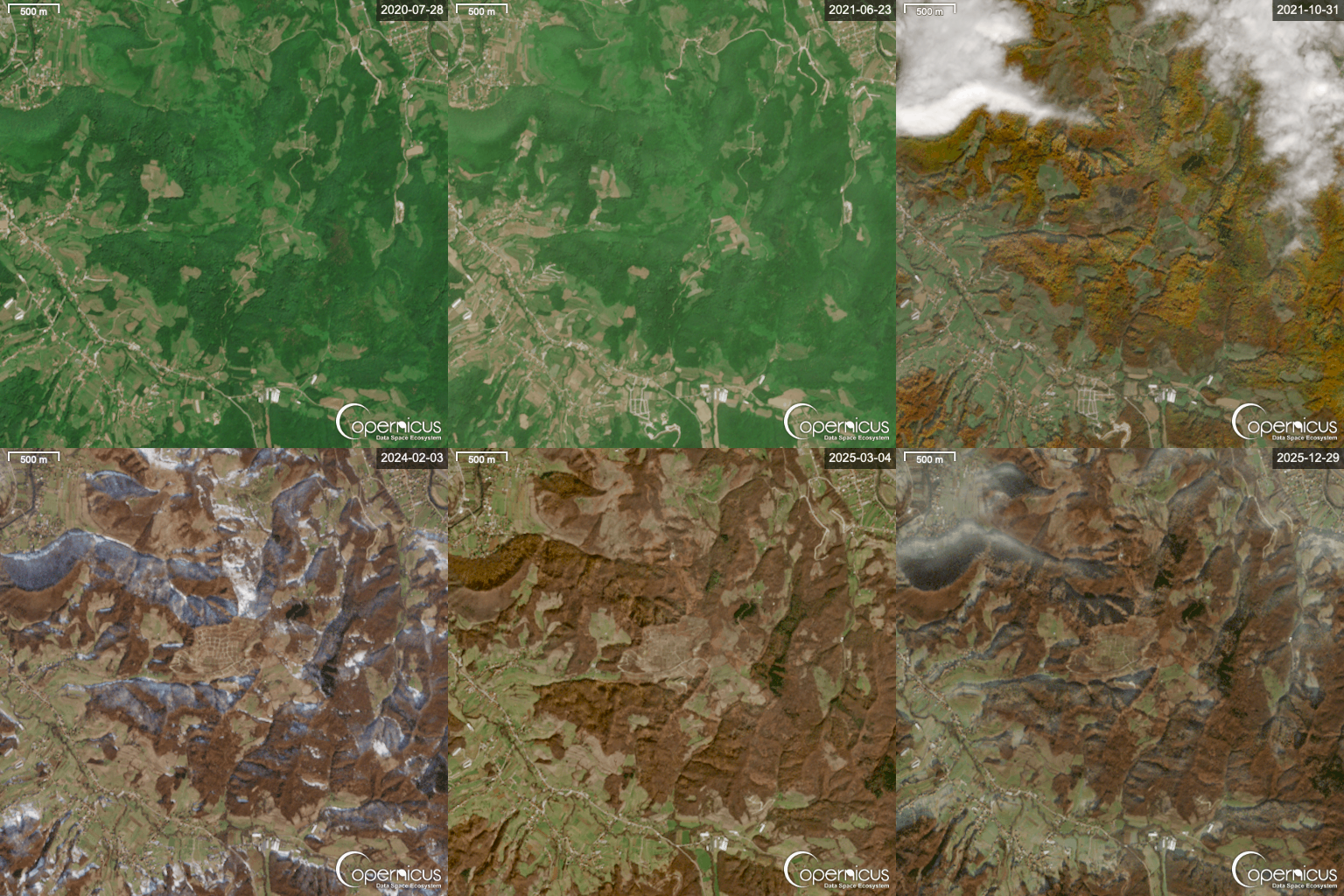
Sentinel images/Before and after forest cutting in the Dobro kod Visoko area
Two weeks before the video of deforestation in Dobro was published by PB-IF in 2023, its owner, Abu Shaibah, met with the mayor of Visoko, Mirza Ganic. At the event, Abu Shaibah was presented with a gift in the form of a painting, by Ganic, who did not respond to Detektor’s inquiry about his connections with the Kuwaiti business man.
In 2022, in the same municipality, Injazat Future representatives had illegally begun the construction of two buildings. Salah Sulaiman Kshash Al-Nidawi, a manager involved in three of the four companies owned by Abu Shaibah, was one of two people convicted and fined by the Municipal Court in Visoko for illegal construction in May 2023.
‘Don’t trust them’
Injazat Future’s HQ is in the Mousa Trade Center in Kuwait City. According to its website, the company also operates in Egypt, Georgia, Germany, and Turkey. In Bosnia and Herzegovina, Injazat has a company with the same name and several companies with the same owner and address.
Injazat Future’s website says that in Bosnia and Herzegovina it owns land in 107 locations, of which much, it says, has already been sold. Despite these claims of healthy sales, two out of three of Abu Shaibah’s companies in Bosnia and Herzegovina operated at a loss in 2024.
Despite efforts by Abu Shaibah’s companies to maintain a good reputation through meetings and diplomatic connections with officials in Bosnia and Herzegovina, comments on social media reveal a less flattering image.
On Injazat Future’s own Instagram and TikTok profiles, comments include: “Don’t trust them, I bought it four years ago and nobody responded to me.” Another warns: “They took the money a few months ago, and they still haven’t contacted me.” “From personal experience, and God is my witness, I bought two plots and now deeply regret it”; “The land is cheap, but construction is the real problem,” others say.
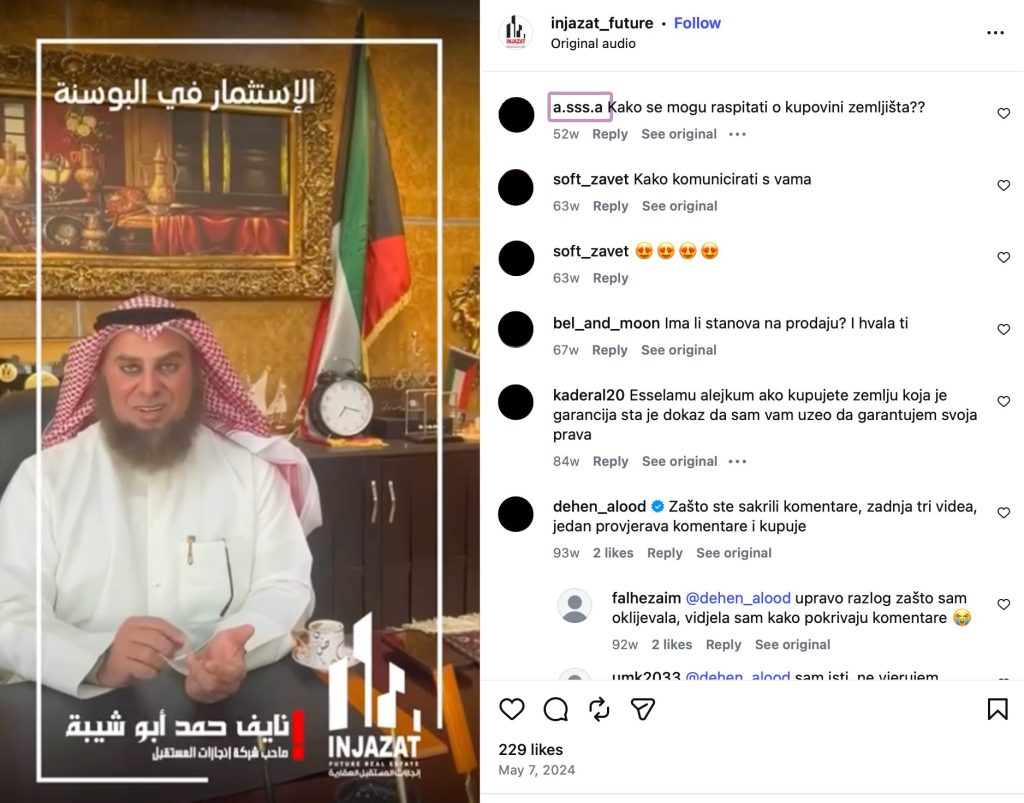
Some of the comments on the account of the company Poduhvati budućnosti – Injazat Future. Photo: Screenshot of Injazat’s Instagram profile
Nevertheless, Injazat Future has been on a charm offensive in Bosnia and Herzegovina.
Abu Shaibah donated a facade for the building of the Majlis of the Islamic Community in Gracanica near Visoko in 2023, and sponsored the Mladost football club from Zupca in Breza. Injazat Future sponsored the Hadzici Summer event just outside Sarajevo in 2025, for which the town officially thanked them on its Facebook profile.
Research has found a plethora of companies founded with capital from Middle Eastern countries investing in real estate in Bosnia and Herzegovina. Aladin Abdagic, editor-in-chief of the Center for Investigative Journalism (CIN) said there were 1,600 such firms by 2019. CIN’s research at the time showed that some of these companies were illegally building large residential complexes.
“They exploited weaknesses in the domestic system, ignoring orders to stop the works and demolish the building,” said Abdagic. “The owners of these complexes would get away with a verbal warning from local authorities, and the works would often be stopped only after they had built most of the planned villas.”
He found court cases against illegal builders were rare and ended with sentences involving minimal fines.
Ghost projects
In 2020, in the village of Sutjescica near Breza, in the centre of the country, Abu Shaibah’s firms bought 2.5 hectares of land which was presented on Injazat Future’s website as being for residential use. With elaborate designs shown online, Injazat Future planned the construction of 43 houses and a mosque on the land in a project it claimed to be worth 2 million Kuwaiti dinars (around 11 million marks / $6.5 million). Yet Detektor found the land was unsuitable for construction and despite Injazat Future selling it to investors, none of the buildings shown in the designs have yet been built.
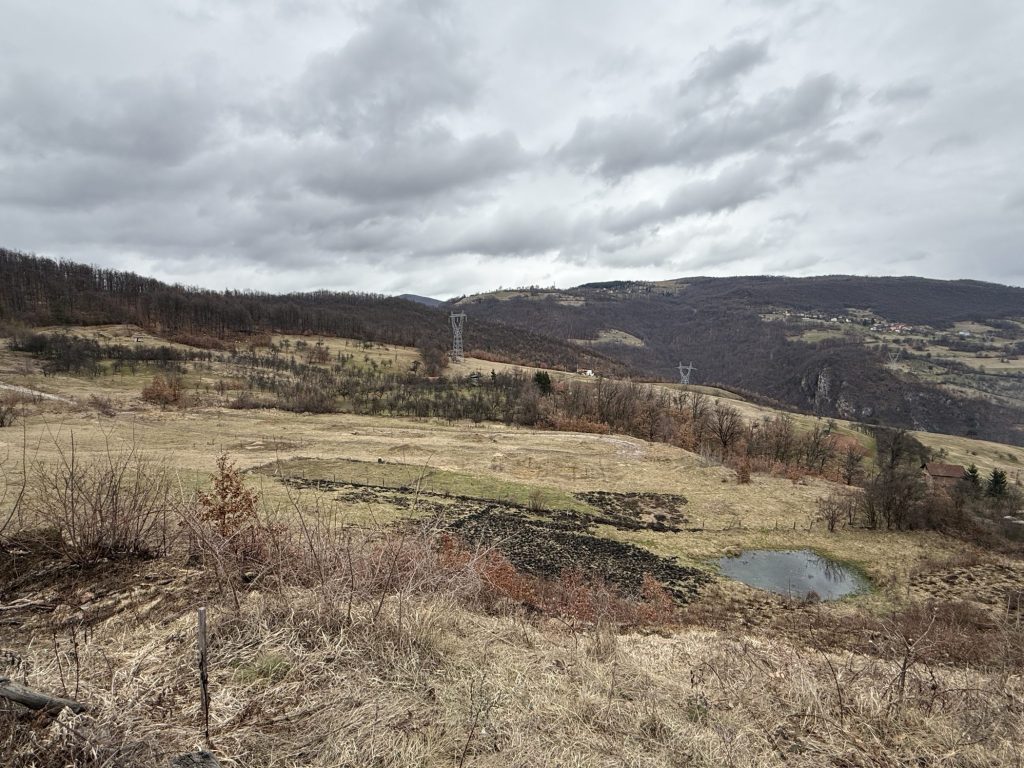
The land owned by the Nayef Abu Shaibah company in Breza where the construction of villas is planned/Photo: Detektor
According to Vedad Jusic, the mayor of Breza, the process of selling land to Arab investors in the area began in 2013. A group of Breza citizens purchased large amounts of land in areas not intended for construction at that time.
“Those plots were then sold to other individuals, legal entities, companies, and foreign investors” who wanted to build on the land, said Jusic. “However, for other reasons, such as the risk of landslide or being on forest land, it was not legally possible to build there.”
Construction on the land is only allowed if geological surveys and other stipulations are carried out, and only after consent has been given by the local planning authority. In practice, for the owners of this land, the regulations mean possible multimillion investments in order to meet the conditions for construction, Jusic explains. According to documents seen by Detektor, so far no such surveys have been carried out, nor consent granted.
Warnings from the Gulf
In a video posted on social media in August 2024, Kuwaiti attorney Fahad Al-Hadad warned citizens about ongoing real estate scams in Bosnia and Herzegovina.
“Most of the affected people are Kuwaitis, especially in Bosnia,” said the attorney, who did not respond to Detektor’s request for an interview. He said real estate firms were selling land not suitable for building on. “These lands are considered agricultural, not residential, he warned.”
Previously, Khaled Al-Harbi, a Saudi influencer and vice president of the Consumer Awareness Raising Committee at the Riyadh Chamber of Commerce, had used a September 2023 TikTok post to discuss the scandal. Under the alias ‘Abueyas’, Al-Harbi said an alleged large-scale land fraud scheme had been uncovered involving companies that were said to have earned millions by selling “non-existent” plots of land in Bosnia and Herzegovina to investors around the world.
Al-Harbi said these companies manufacture fake documents of land ownership, often printed on simple, green A4 sheets. In his post, he mentioned a person with an “orange beard”, whom he did not name. People noted in the comments that Abu Shaibah had an orange beard, but the influencer did not respond. He also did not respond to Detektor’s invitation to discuss and clarify his claims.
In January 2026, Kuwaiti attorney Abdullah Alkhwash published a Kuwait court ruling by which an unnamed real estate company was obliged to pay a 13,000 dinar fine (equivalent to around 65,000 marks or $42,000) after having jointly sold land in Bosnia and Herzegovina to a Kuwaiti citizen, which later proved unsuitable for construction.
The attorney explained to Detektor that all such companies deal with the sale of land under the pretext that it is intended for residential construction, only for it to later turn out that the land can only be used for agricultural purposes or for forests.
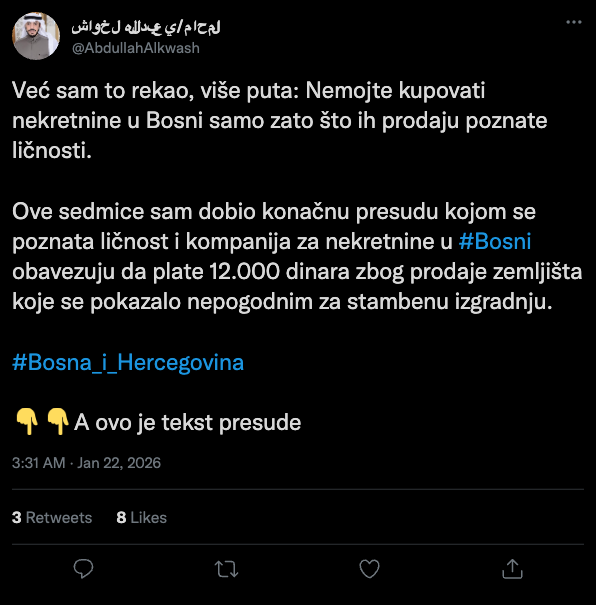
Kuwaiti lawyer Alkawsh’s announcement about the verdict. Photo: Screenshot of translated announcement on X
“I previously published warnings through my personal reports, emphasising the importance of caution, adhering to appropriate procedures, and conducting in-depth analysis before purchasing land or signing contracts,” Kuwaiti attorney Abdullah Alkhwash told Detektor.
“It should be noted that all the cases I filed against these companies have been successful and none has been lost,” attorney Alkhwash stated without naming the companies.
He notes that there are several rulings in similar cases. “Some of them order companies to terminate sales contracts due to failure to fulfill contractual obligations related to the construction of villas according to the agreed specifications. Other judgments annul sales contracts after it was determined that the land was not intended for residential construction, and the companies were ordered to return the amounts paid along with compensation.”
Due to the trend of fraudulent practices in Kuwait, at the end of 2024, then Minister of Commerce and Industry Halifa Abdullah Al-Ajil issued a recommendation stipulating that real estate can only be advertised with the owner’s consent, with accurate and complete information, and with notification of competent authorities. The recommendation states, among other things, that it is forbidden to conceal defects that affect the value of the property or the decision to purchase. The Kuwaiti Ministry of Commerce did not respond to Detektor’s invitation to clarify this warning.
Powerful connections
Laws in Bosnia and Herzegovina prohibit foreigners from directly owning land. To bypass this, Abu Shaibah offers two options: registering land in the name of Injazat Future, with a waiver agreement that gives the buyer full usage rights, or establishing a Bosnian company owned by the buyer. Though he does not recommend this due to “high taxes and lengthy procedures”.
Via his company’s social media feed, Abu Shaibah informs potential buyers from the Gulf that obtaining building permits takes about a month. Injazat Future also offers construction services on a “turnkey” basis, promotes investments in Bosnia as a “strategic opportunity” and claims that the potential entry of Bosnia into the EU could increase real estate values several times.
His marketing largely relies on social media campaigns and showing off his connections with the authorities in Bosnia and Herzegovina. In one such post, the Ambassador of Bosnia and Herzegovina to Kuwait, Nusret Cancar, also appears at a meeting with Abu Shaibah.
When asked about his meeting with Abu Shaibah, Cancar told Detektor: “It was a collective reception. They were interested in possible changes and further forms of cooperation, and I informed them. Injazat Future was also there at the time. And I, nor anyone else, have the authority to make a selection of whom we will receive and whom we will not receive. It was a public meeting, and everyone who was interested attended, including this gentleman, among others.”
In October 2025, Abu Shaibah met with the Prime Minister of the Zenica-Doboj Canton, Nezir Pivic, and Ahamn Alshlimiy, a civil servant in the Government of Kuwait. Abu Shaibah was introduced as a Kuwaiti investor who, on that occasion, emphasised that he was satisfied with the investment environment but that nevertheless “there are obstacles of administrative nature that slow down new investments and business expansion”, according to Pivic.
“Before the meeting and also after the meeting with Mr. Abu Shaibah, I was not aware that any proceedings had been conducted against the Poduhvati Buducnosti – Injazat Future company. I met Mr. Abu Shaibah for the first time at a meeting in the Prime Minister’s Office held on October 14, 2025, and after that meeting we had no contact.”
Abu Shaibah has posted photos on Injazat Future’s social media, depicting him with Adil Osmanovic, a long-time SDA (Party of Democratic Action) official, who is currently a member of the House of Peoples of Republika Srpska and a secretary in the Naprijed party. In the same post, there are also photos with the mayor of Breza, Vedad Jusic, the mayor of Visoko, Mirza Ganic, and former mayors of Ilijas, Akif Fazlic, and of Vogosca, Edin Smajic.
Osmanovic confirmed to Detektor that he attended a meeting with businessmen at the Malak Hotel, where he said “a Kuwaiti sheikh” who owned Injazat Future, and several municipal mayors were present.
“At that time, I was a member of the House of Representatives, and when inviting me, they told me that, in addition to businessmen, representatives of the Kuwaiti parliament would also be there.”
Osmanovic said investment opportunities in Bosnia and Herzegovina were discussed at the meeting. “Businessmen and the sheikh were particularly interested in the possibility of exporting chicken meat to Kuwait as well as the possibility of investing in agriculture in Bosnia and Herzegovina,” Osmanovic told Detektor, pointing out that he has no other contacts with Abu Shaibah.
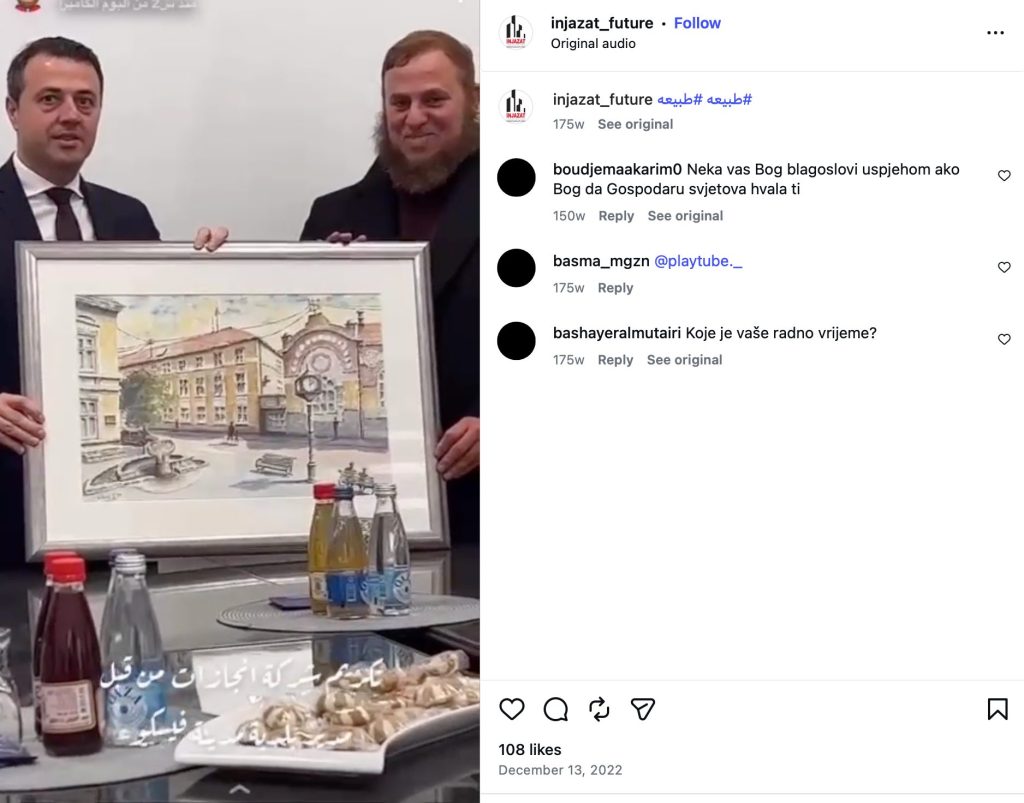
Mayor of Visoko Mirza Ganić presented a gift to Abu Shaiba. Photo: Screenshot of Injazat’s Instagram profile
In 2017, Abu Shaibah met with the former Bosnian ambassador to Kuwait, Mehmed Halilovic. From that year, according to the website Istraga.ba, the money that Kuwait donates to Bosnia and Herzegovina has been paid in cash instead of being transferred through bank accounts. From then until 2023, at least 1.2 million euros disappeared from the Bosnian embassy in Kuwait, according to the website. The former ambassador said that he does not remember signing any documents relating to the missing embassy money.
Halilovic told Detektor that following a request from Kuwait, he advocated for a law that would allow Kuwaitis to buy land and real estate in Bosnia and Herzegovina. He could not remember the details of the meeting with Abu Shaibah.
The Prosecutor’s Office of Bosnia and Herzegovina told Detektor it has “an ongoing case related to allegations of misuse of donations from Kuwait”. It said the case is in the verification phase, no prosecutorial decision has been made.
So far court proceedings and legal barriers that prevent construction on locations bought by foreign investors and owned by Abu Shaibah’s companies have not stopped him from continuing to actively promote the natural beauties of Bosnia and Herzegovina to attract buyers from Gulf countries.
“Snow season in Bosnia, the land of beauty,” is written in Arabic in one of the company’s latest Instagram posts along with a video of a snow-covered forest road.
Detektor received no response to emails sent to the Injazat Future company address. Attempts to contact them via WhatsApp messages and other networks were also unsuccessful.

This research was produced in collaboration with the Arab Reporters for Investigative Journalism, ARIJ, with the support of the Journalismfund Europe.