



This post is also available in:
From goal netting to a house in the Bosnian town of Trebinje, ‘adking’ is a prolific purveyor of goods on the Serbian classifieds site Mali oglasi.
Contactable via WhatsApp, Telegram and the ultra-secure Swiss messaging app Threema, ‘adking’ has used Mali oglasi to offer more than 4,000 different services and products for sale.
Recently, using a fake number and identity, BIRN got in touch via WhatsApp, not to ask about houses in Bosnia or football paraphernalia, but about something far more sinister – nitazene.
A synthetic opioid, nitazene is considered more potent than fentanyl, heroin or morphine. And now BIRN has identified dozens of online ads offering deliveries of the illicit drug to the Balkans, among them ‘adking’.
“We send to Europe,” the person behind ‘adking’ responded in English. “We send from Spain.”
When asked if nitazene could be sent, for example, to Bosnia and Herzegovina, the seller said it could and provided a link to an online store where protonitazene is listed for sale alongside crystal methamphetamine, heroin, and tramadol.
The price? 105 euros for 10 grams, or up to a kilogram for 2,220 euros.
“We mostly use FedEx and DHL,” the seller said. “Spain to Bosnia is 3-4 days max.”
Pressed for proof, they sent a photo taken by mobile phone of a delivery document concerning a previous package shipped by DHL to Homoljska Cuprija in Bosnia’s Zenica-Doboj canton. The package weighed 89 grams and was sent by plane, though BIRN could not independently verify the document.
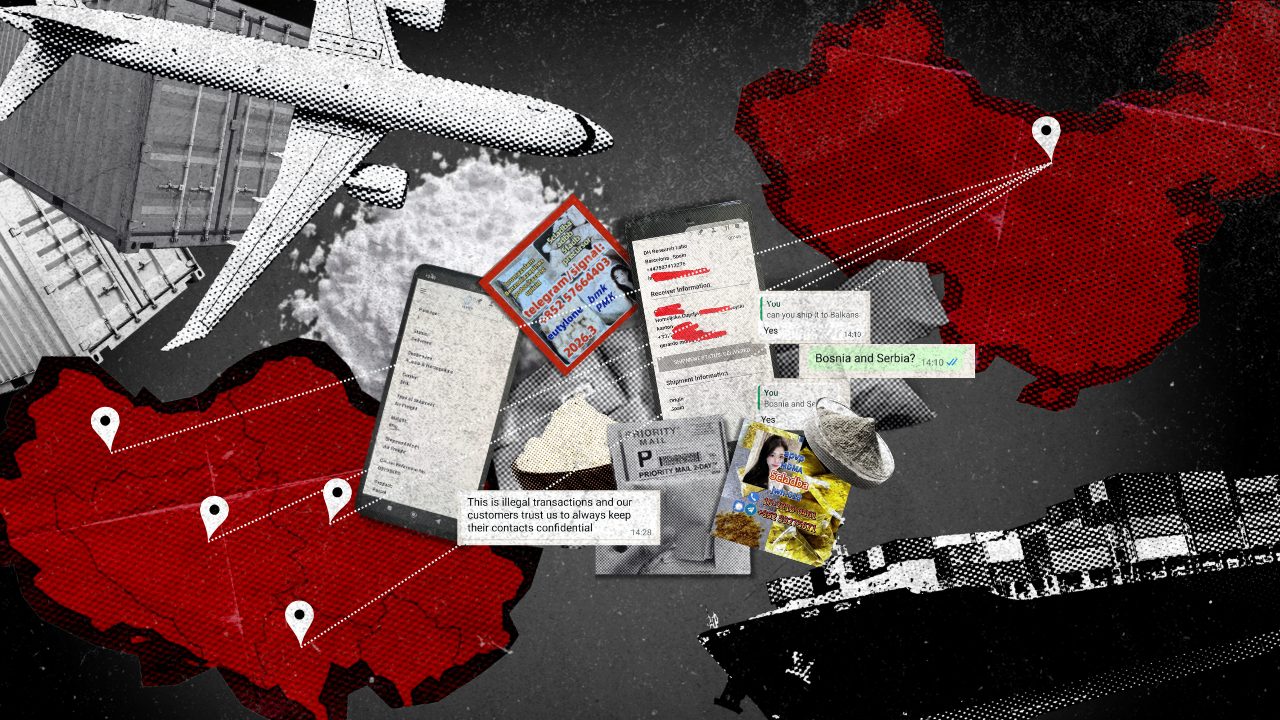
Over a weeks-long investigation, BIRN followed the online trail to China, where Western law enforcement agencies believe most of the nitazene seized in Europe originated.
Since 2019, at least 21 countries in Europe have registered the drug’s presence, said Ruggero Scaturro, senior analyst at the Global Initiative Against Transnational Organised Crime, GI-TOC.
“Seizures have risen quickly, with nitazene powder detections tripling to 10 kg in 2023,” Scaturro told BIRN. “They have also been linked to overdose clusters and deaths, especially where they are sold as fake oxycodone, benzodiazepines or even heroin.”
“China has been an important source country for synthetic drug precursors and finished substances, but the model is not always dominated by classic mafia-type organizations; in many cases it appears to rely on smaller, flexible online networks and vendors.”
For ethical reasons, BIRN terminated its contact with nitazene sellers at the point it was expected to confirm an order. Before doing so, the journalists identified themselves. The sellers then refused further communication unless, some said, they were paid.
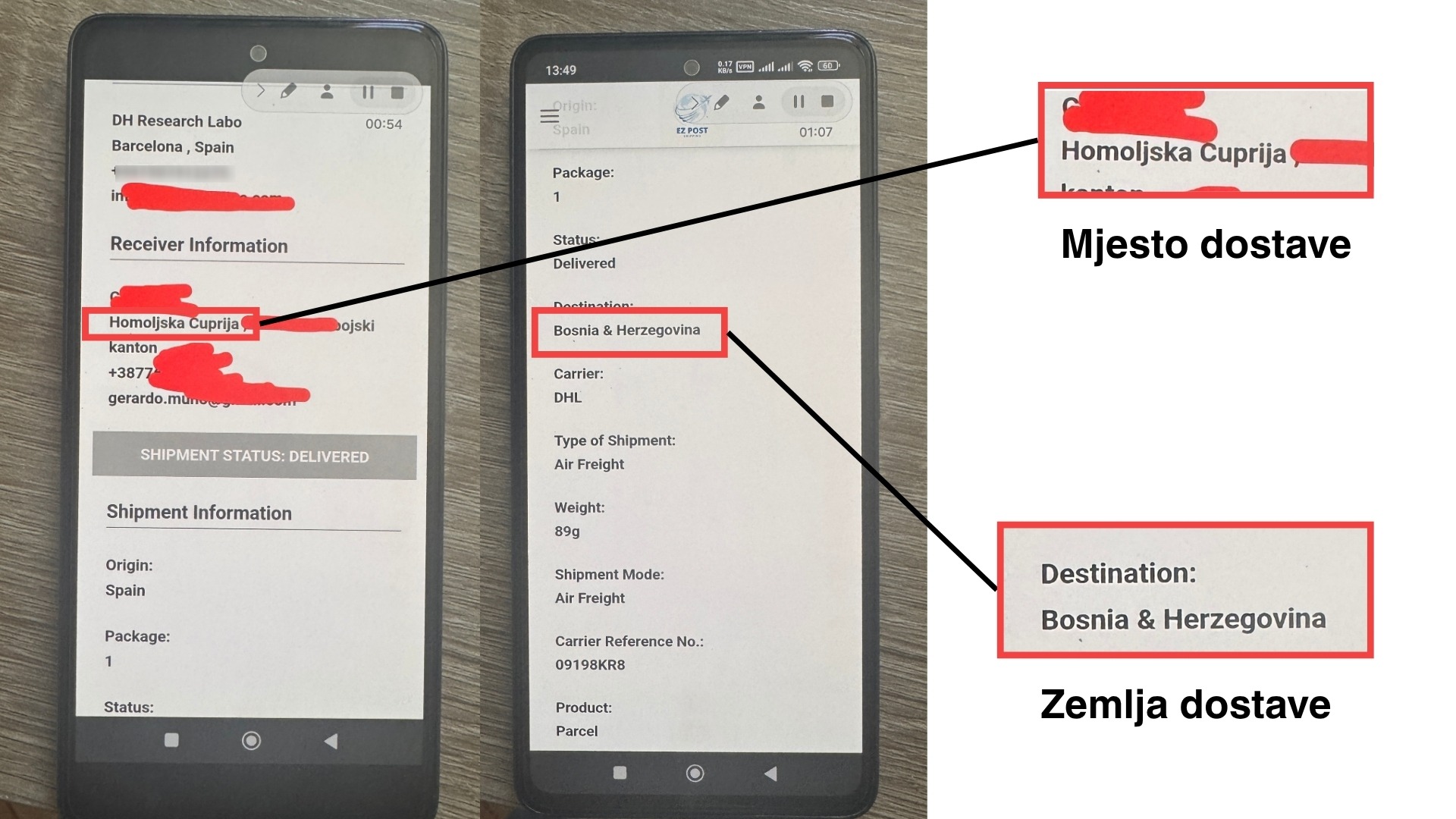
Delivery notes shown to BIRN as proof of delivery to Bosnia and Herzegovina. Photo: BIRN
Inside the ads
BIRN analysed almost 30 online ads targeting Bosnia, Serbia, Croatia and Montenegro and mainly offering subtypes of nitazene – protonitazene, isotonitazene, and metonitazene – that vary in strength.
Most of the ads are brightly coloured and accompanied by photographs of young women of Asian appearance and packets containing powdery substances. Written in Bosnian, Croatian, Serbian and English, the ads promise fast delivery and discretion.
Behind the pretty pictures, data from national and international anti-drug agencies show that hundreds of deaths in Britain, the European Union, and North America have been attributed to nitazene.
Besides ‘adking’, nine other sellers contacted undercover by BIRN offered to send nitazene anywhere in the world. Two said they sent their goods from Europe and one from Georgia.
One, reached on Telegram, said they accepted payment in cryptocurrency.
“Minimum order is 175 euros,” wrote the seller, whose profile said they are located in Rijeka, Croatia.
“Bro, we do 100% double vacuumed sealed and you receive it with no problem.”
This seller’s ad was published in May last year on the Bosnian site ASoglas, under the category ‘Watches’.
Photos on the seller’s Telegram account suggest they have previously delivered to the Bristol area of Britain.
The investigative media network Bellingcat was first to report on the flow of nitazene from China to Europe via major courier services.
“What we saw is that these vendors are openly advertising on the internet (on their own websites, social media, and legitimate e-commerce platforms), bragging about their ability to deliver safely to Europe,” said Connor Plunkett, a Bellingcat researcher who worked on the story.
Bellingcat identified the appearance of nitazene in at least 20 European states since 2019, corresponding to a rise in overdose deaths attributed to the opioid.
“I think the persistence of these types of online vendors shows they are having continued success, and if it works for one synthetic substance then there’s every reason to think it will work for others,” said Plunkett.
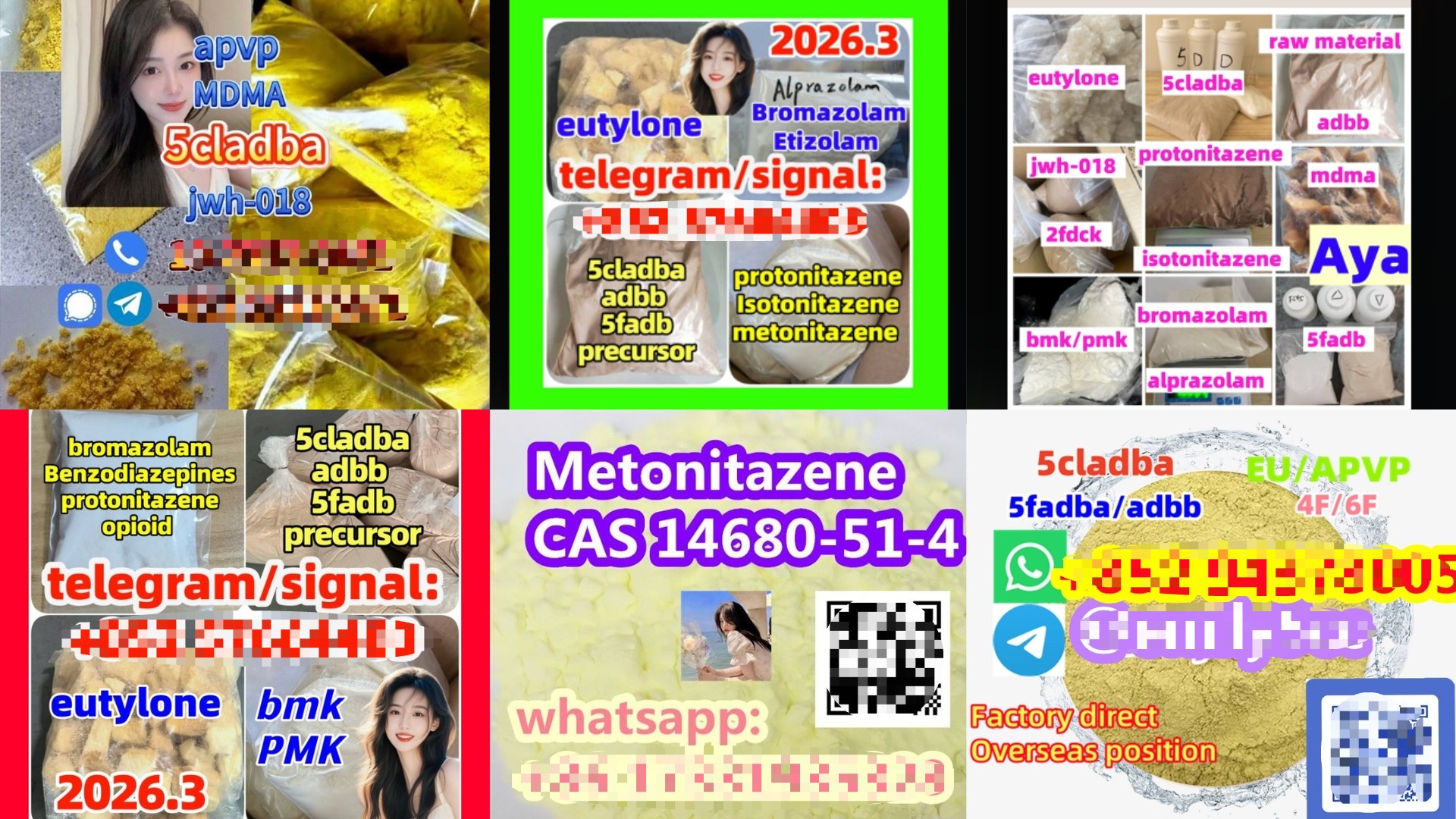
Ads discovered by BIRN journalists. Photo: Screenshot
‘I delete them immediately’
The German courier and logistics giant DHL said intercepting illegal substances is the responsibility of customs and law enforcement authorities.
“DHL will continue to work closely with law enforcement and customs authorities worldwide to identify, assess and respond to evolving threats across the global supply chain,” the company said in a written response for this story.
FedEx said it does not tolerate the use of its service for illegal purposes and that it has strong security procedures and compliance procedures in place.
“We cooperate fully with customs and law enforcement authorities worldwide and do not comment on specific shipments, security measures, or ongoing investigations,” FedEx told BIRN.
The owner of Mali oglasi, who identified himself as ‘Andrija’, said he had not noticed any ads on his site for nitazene.
“All ads have been checked and manually published since last year, but in the older version of the site from two years ago and earlier, whose remnants are still on the current site, this was not the case, so all sorts of things were published there,” Andrija told BIRN in a written response.
After BIRN’s inquiry, adking’s nitazene ad was deleted, as were some others offering opioids.
“They occasionally try to publish similar ads, which means that this operation is still ongoing, but since I now check them manually every day, I delete them immediately,” said Andrija.
Alerted to the ads on his site, Dejan Spasojevic from ASoglas said both the ads and the profile would be deleted immediately. Additional restrictions would be introduced, he told BIRN.
“We have never supported anything illegal, so we are uncomfortable that such ads appear.”
In Montenegro, the classifieds site prodajemkupujem deleted all ads offering nitazene after being alerted by BIRN.
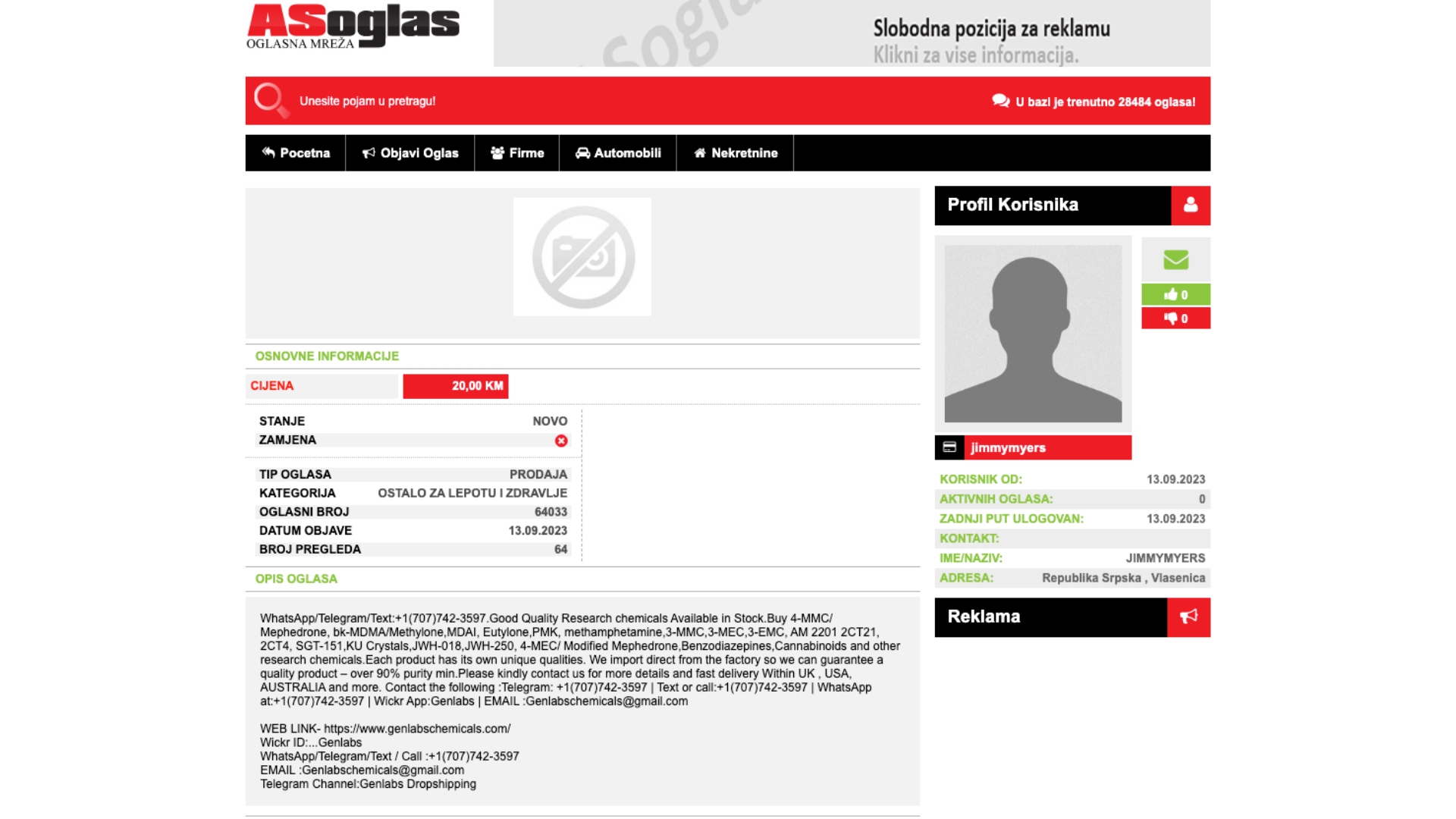
A seller claiming to be in Vlasenica, eastern Bosnia and Herzegovina. Photo: Screenshot/ASoglas
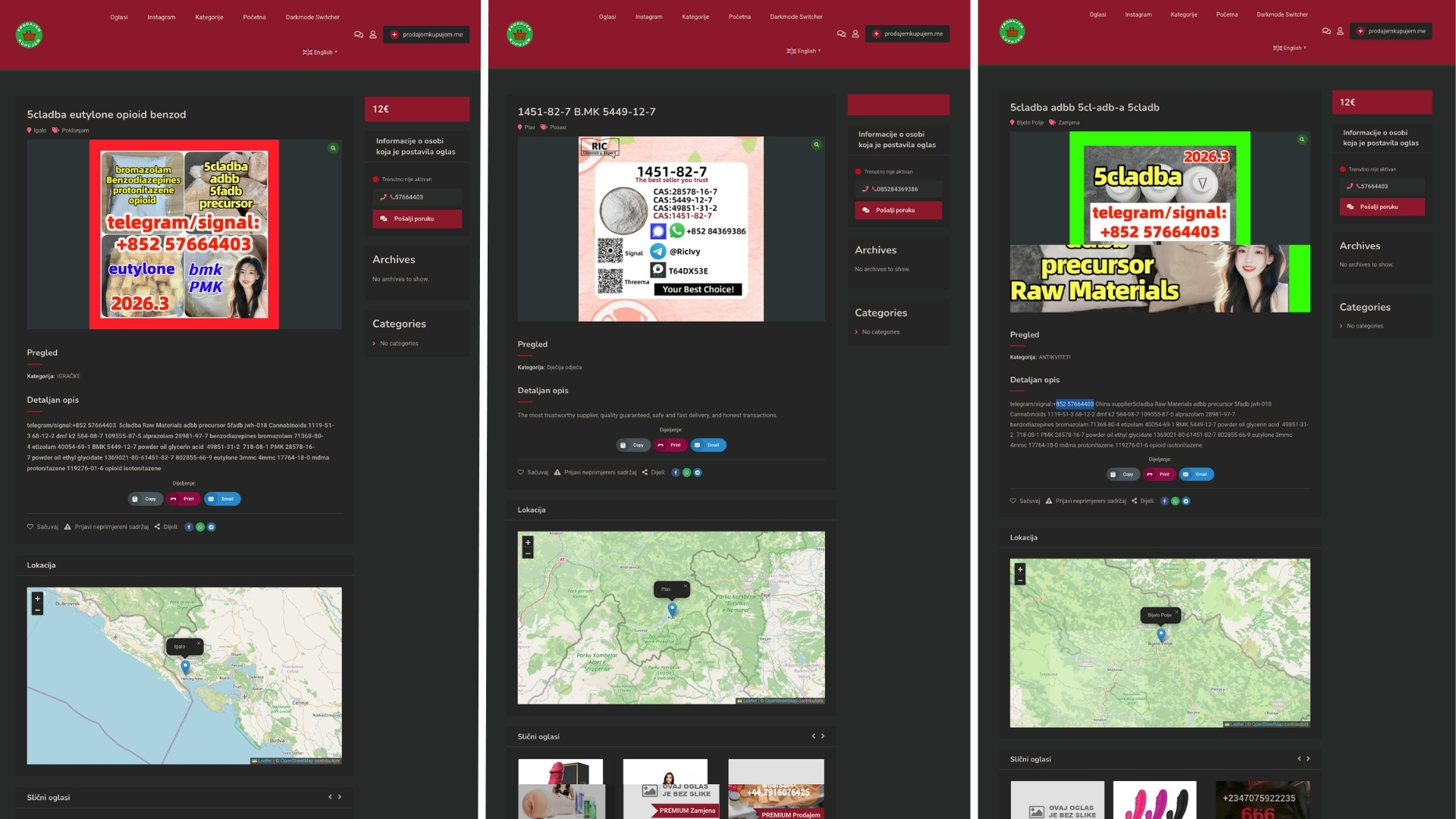
Ads from the portal Prodajemkupujem.me, later deleted, offer nitazene for sale in Montenegro. Photo: Screenshot
Sichuan, Zhengzhou…
Like Bellingcat, BIRN found that behind several profiles offering synthetic opioids in the Balkans are online stores.
The identities of the actual owners of these stores are hidden, but BIRN traced the servers used by three of them to Lithuania, China and Malaysia.
The online store Larsaarup, for example, uses a Cypriot IP address but the hosting services of the Lithuanian company Hostinger Operations UAB, from which the domain was purchased. Contacted by BIRN, Hostinger Operations UAB removed the website, saying it had no previous knowledge of its activities.
“We rely on a combination of internal systems, external signals, and reports from users, partners, and trusted flaggers to detect potential abuse, including illegal trade in controlled substances,” the company told BIRN. Citing legal restrictions, Hostinger Operations UAB said it was unable to share any information about the website’s owner other than with law enforcement agencies.
The online store Genlabs Chemicals was registered in Malaysia with the end user listed as ‘Hans Chicago’ at 3075 Limer Street, Chicago. BIRN was unable to verify the existence of either ‘Hans Chicago’ or the listed address.
The third store, suppliersyjil, is registered with Alibaba Cloud Computing LTD. The page’s content, however, is not stored with the Chinese tech giant Alibaba but the Chinese marketing platform Globalso, which specialises in connecting Chinese manufacturers with the global market.
A representative of suppliersyjl offered to send nizatene to Bosnia but halted communication when the BIRN journalists identified themselves.
Alibaba, and Globalso did not respond to requests for comment.
The site owner is listed as being located in the Chinese province of Sichuan, while the website itself purports to be part of Dejuru Pharmaceutical Co., Ltd, in Zhengzhou. No company under this name exists in any official registry and the address listed on the website is a Chinese national technology park.
Suppliersyjl advertises its products in more than 100 languages, including all languages of the Western Balkans, both in Cyrillic and Latin scripts. The site appears to use photos from other companies to promote itself.
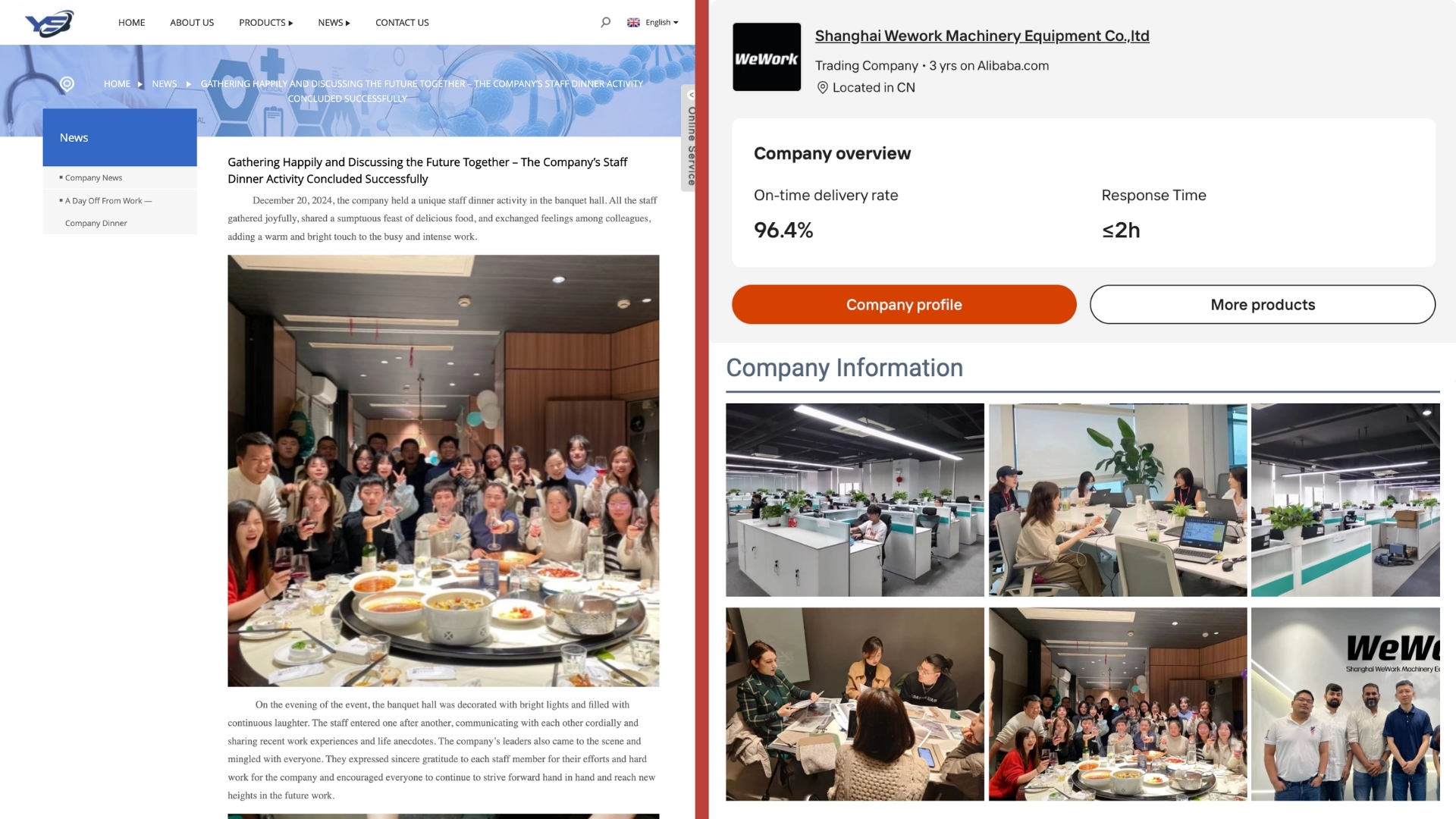
The online drug store suppliersyjl (left) promotes itself using photos from the Alibaba profile of another company (right). Photo: Screenshot
BIRN came across another online store, amarvelbio, offering nitazene on the classifieds site Halo Oglasi.
The amarvelbio domain was seized in June 2023 by the US Drug Enforcement Administration, DEA, which said it served as the main online channel of the Chinese company Hubei Amarvel Biotech for global sales of fentanyl precursors, with a particular focus on the US and Mexico.
According to the US Department of Justice, the key figures behind the store were arrested in 2023 and sentenced in 2025 to 25 years in prison for fentanyl trafficking.
Halo Oglasi did not respond to a request for comment.
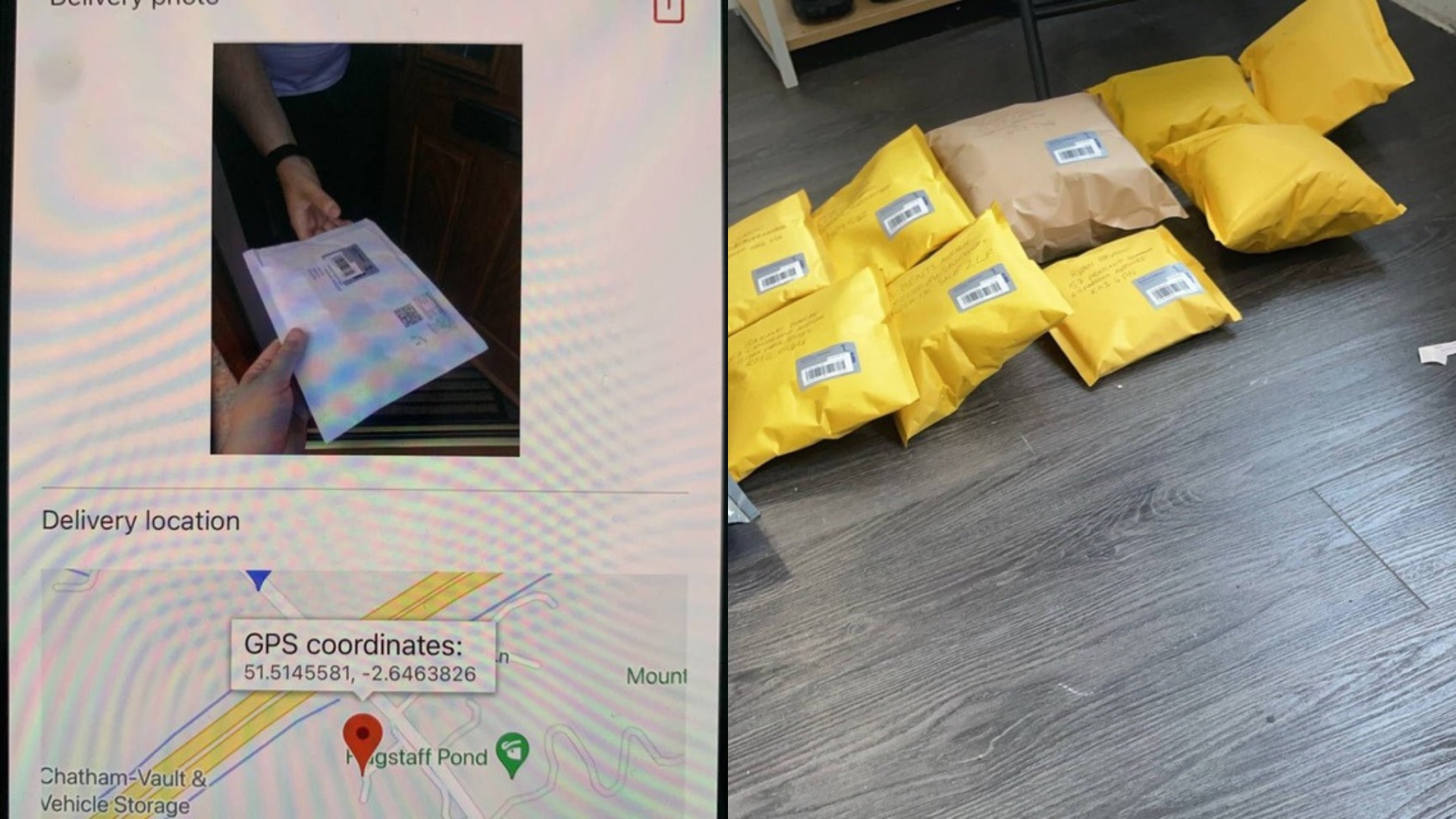
Dealers regularly post photos of packages and deliveries to addresses. Photo: Screenshot
Cases likely being missed
According to Scaturro, traders of nitazene prefer to use digital and fragmented distribution models, in which traditional routes have been replaced by websites, encrypted data exchange applications, and courier services.
Sales are often conducted in very small quantities, he said, which are easy to hide and difficult to identify without targeted intelligence and advanced screening. Parcel and courier systems are integral to the transport of such goods, which makes systematic inspection almost impossible.
“Nitazenes are not always captured by routine toxicology or standard field tests unless laboratories are specifically equipped to look for them,” said Scaturro. “In the Western Balkans, that likely means some cases could be missed in both seizures and post-mortem analysis.”
In October 2024, the US Department of Justice published a report detailing the use of e-commerce platforms and cryptocurrencies by Chinese entities to conceal transactions and send high-potency synthetic opioids under false customs declarations.
According to a 2024 joint report by the EU Drug Agency and Europol and another the same year by the British Home Office, most of the nitazene seized in Europe and Britain can be traced back to laboratories in China.
The documents specify that Chinese manufacturers adjust the molecular structures to avoid existing bans, sending “pure” nitazene powders to the EU and UK, where they are then mixed with heroin or pressed into fake oxycodone pills.
China says it has introduced stricter controls, especially concerning chemicals for the production of nitazenes, in an attempt to prevent their illegal export. The country’s Ministry of Public Security said it has intensified oversight of the chemical industry and online platforms used for selling these substances abroad.
BIRN contacted the interior ministries of Serbia and Montenegro as well as Bosnia’s State Investigation and Protection Agency, SIPA, and public prosecution service but received no response.
The Croatian ministry said it had not seized any nitazene but told BIRN: “Everyone within the national system is aware of the dangers of fentanyl and nitazene abuse, including Customs and Croatian Post, as well as legal entities working in the ports of Rijeka and Ploce, related to the traffic of goods.”