


This post is also available in:
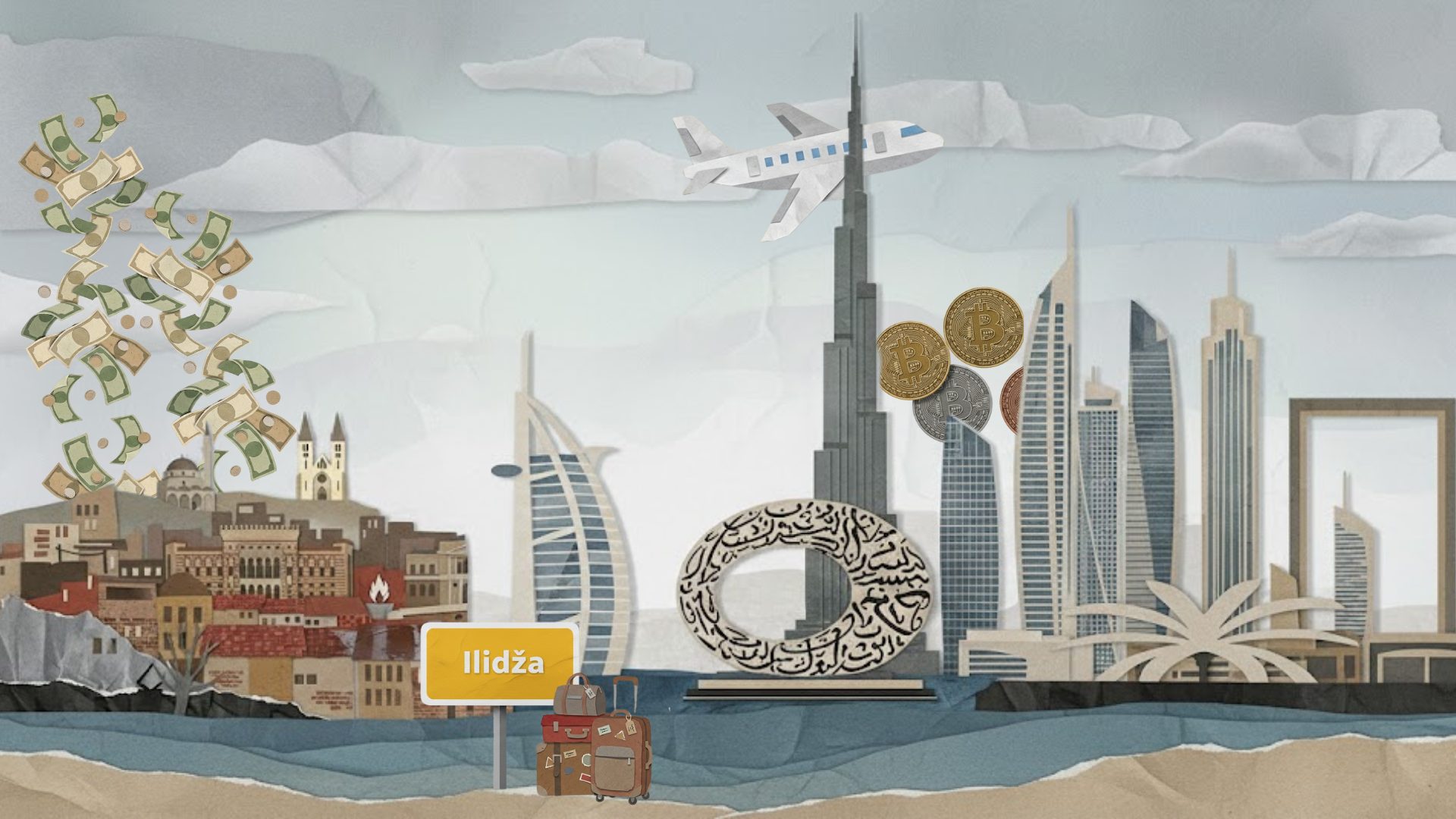
Offering apartments for sale in Dubai, a Sarajevo-based real estate firm is claiming it can circumvent rules requiring proof of where the money for the purchase comes from, BIRN can reveal.
Posing as a representative of Russian and Bosnian clients, a BIRN journalist met representatives of Park Group Dubai on two occasions in October and November last year and enquired about properties worth up to 200,000 euros each.
The owner and director of Park Dubai Group is , who has tried to launch several luxury real estate developments in and around the capital of Bosnia and Herzegovina, so far without success.
In October, this journalist met three representatives of Park Dubai Group, including Yousuf, at the company’s offices in the old bazaar of central Sarajevo, known as Bascarsija. A second meeting in November involved just one representative.
At the October meeting, the representatives said buyers can pay by bank transfer, cash and cryptocurrency, and described a possible transaction by which an amount of cash would be paid in Bosnia and the same amount transferred to developers by local partners in Dubai, so that no money would cross borders. This is commonly known as ‘hawala’.
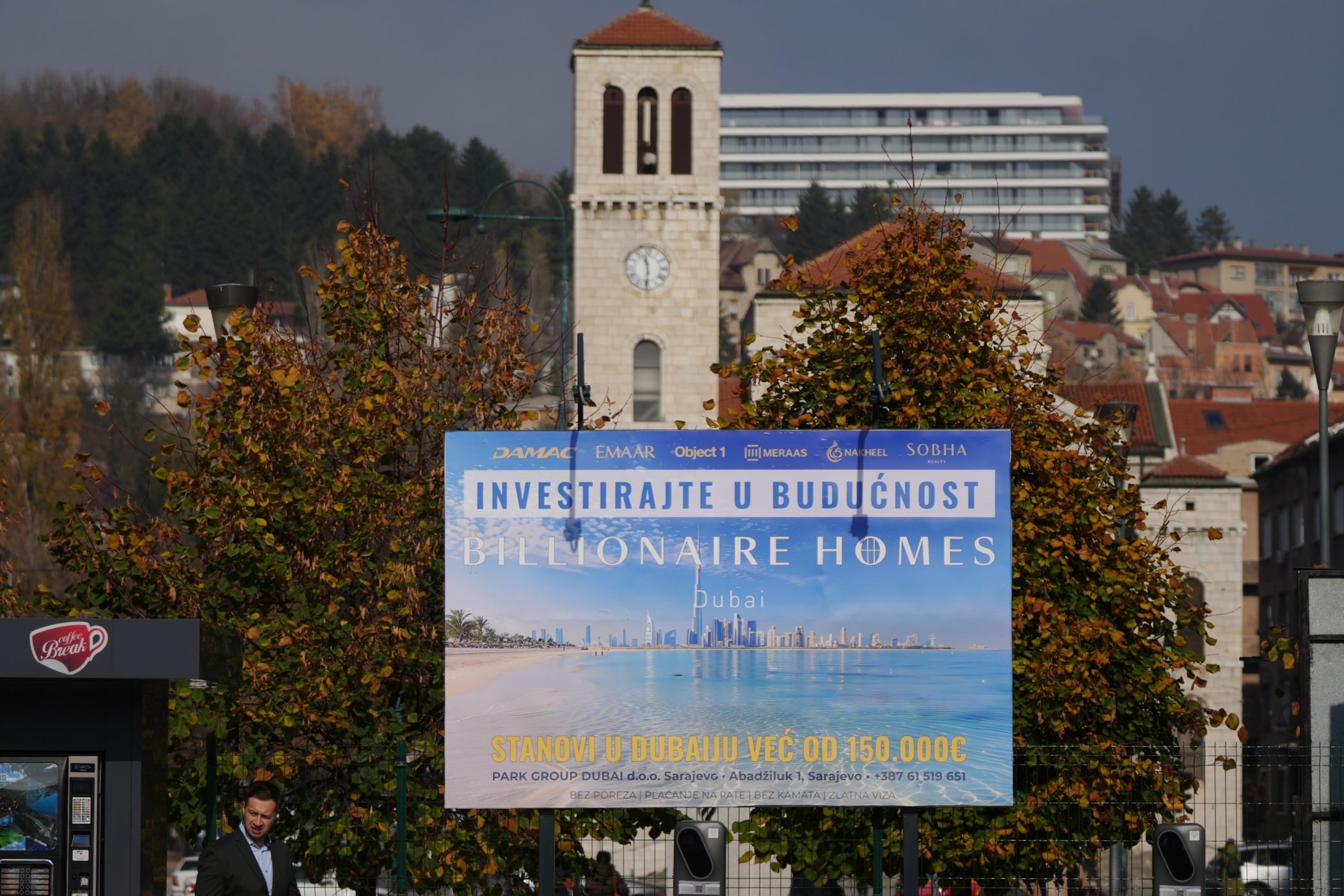
Park Group Dubai advertisement for the purchase of real estate in Sarajevo. Photo: Detektor
“No paperwork is needed,” said one representative. “Proof of the origin of money is not required. The transfer can be done through a bank, web transfer, via an account, in cash. Everything is possible. Everything can be arranged.”
“You can tell them that it absolutely does not matter where the money comes from or where the clients come from,” the representative said. “If the money has not been legalised, if it is cash, the client should not think about it. It is our responsibility how it will be transferred,”
Some of the claims appear to run counter to laws in both Bosnia and the United Arab Emirates, the latter described by the Washington-based organisation C4ADS, which deals with global security issues, as a “haven” for the concealment of wealth obtained illegally.
Nerminka Hamidovic, president of the Notary Chamber in Bosnia’s Federation entity, said it is illegal in Bosnia to buy real estate in Bosnia or abroad in cash when the amount in question exceeds 30,000 Bosnian marka, or roughly 15,000 euros.
“This is a violation of the Law on the Prevention of Money Laundering,” Hamidovic told BIRN. “Real estate agencies are subject to this law, just like notaries, just like bankers, just like lawyers. Therefore, any cash payment is a criminal offence.
Asked for a response to this story before publication, Park Group Dubai denied acting outside of the law, telling BIRN: “We do not offer or participate in arrangements that would constitute circumvention of checks on the origin of funds […] or any actions that are not in accordance with the law.”
Money laundering risks

Park Group Dubai office in Sarajevo. Photo: Detektor
In an effort to tackle money laundering, laws in both Bosnia and the United Arab Emirates require real-estate buyers to provide proof of origin for their purchase funds, and since 2022 real estate developers and brokers in the UAE are obliged to report payments comprising or deriving from virtual assets and cash payments over roughly 12,800 euros to the Financial Intelligence Unit.
Hawala services and cryptocurrency transfers are not legally defined or regulated in Bosnia.
The UAE’s Financial Investigation Unit says hawala services pose a risk for money laundering, while Zeljko Ricka, a professor of economics and finance in Bosnia, said: “The Strategy for Combating Money Laundering lists risk from cryptocurrencies as one of the main risks in Bosnia”.
In February last year, the Council of the Europe’s anti-money laundering body, Moneyval, called for “major improvements” in a range of areas in Bosnia, including risk understanding, international cooperation, use of intelligence and investigations into money laundering and financing of terrorism.
It found that, while banking supervisors “have a comprehensive understanding of ML [money laundering] risk… in most other sectors, the concept of risk identification and assessment is still nascent”.
Ricka said the Moneyval scrutiny requires Bosnia to pay attention “to every transfer, with evidence and verification”.
With the one-year observation period close to ending, the European Union delegation to Bosnia warned that without “significant progress” in addressing the deficiencies cited by Moneyval, there was a “high probability” that the Financial Action Task Force, a global money laundering and terrorist financing watchdog, would list Bosnia as under increased monitoring, commonly known as ‘grey listed’.
“Greylisting would have immediate and tangible consequences for businesses, banks, payments, investment and the Bosnia and Herzegovina’s economic credibility, affecting access to international financial markets and transactions, private commercial activities as well as public fiscal affairs,” the delegation warned.
Denial
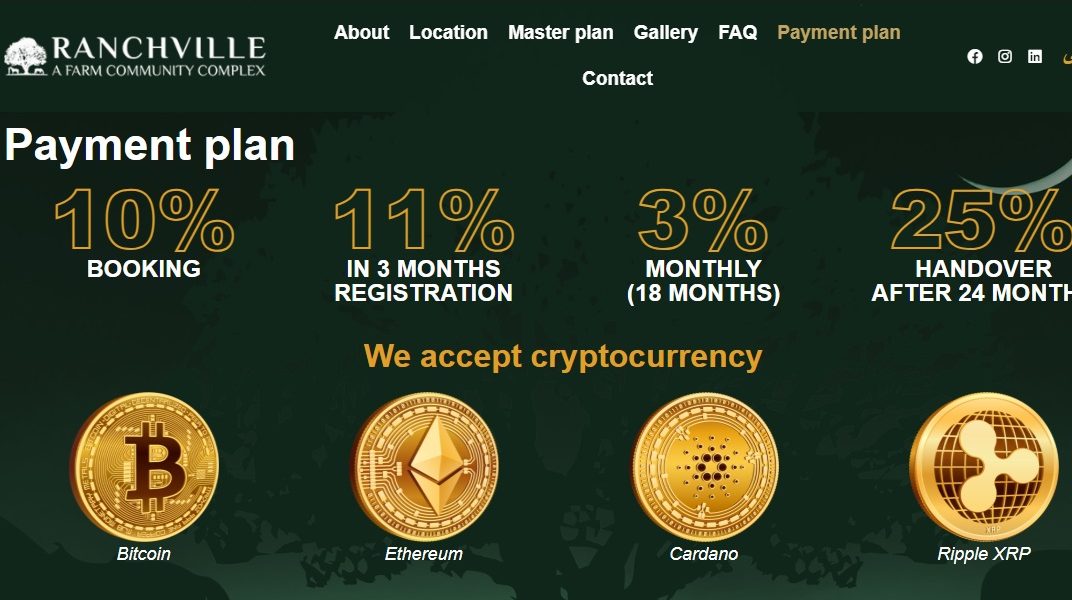
Cryptocurrencies as a way to shop on the Park Group Dubai website. Screenshot: Ranchvillebosnia.parkgroupdubai.com
Presented with BIRN’s findings, Park Group Dubai denied any wrongdoing.
“Foreign buyers in the UAE undergo checks by developers [investors] that include verification of compliance with international regulations,” the company said.
“Agencies and representative offices do not receive money and do not participate in financial flows, nor do they offer any alternative or informal payment methods. This system exists precisely to prevent illegal activities, including money laundering.”
“Our role does not include, nor has it ever included, the transfer of money in any form. We do not receive, hold, direct, or facilitate clients’ financial flows.”
The company emphasised that “payment in cash or cryptocurrencies is possible only where the developer [investor] explicitly allows it and in accordance with UAE laws”.
Park Group Dubai said it had only been advertising property sales in Dubai for a few months and had yet to close a sale.
Criticism of UAE real state practices
According to Transparency International, the UAE allows real estate transactions to go ahead “without any mandatory involvement from professionals subject to anti-money laundering obligations”.
“That means property can change hands without a lawyer, agent or notary being legally required to ask who the buyer is or where their money comes from.”
C4ADS said that limited transparency regulations and minimal disclosure standards in the UAE allow companies in Dubai to conceal the identities of real estate buyers by using shell companies and intermediaries, as well as offshore entities.
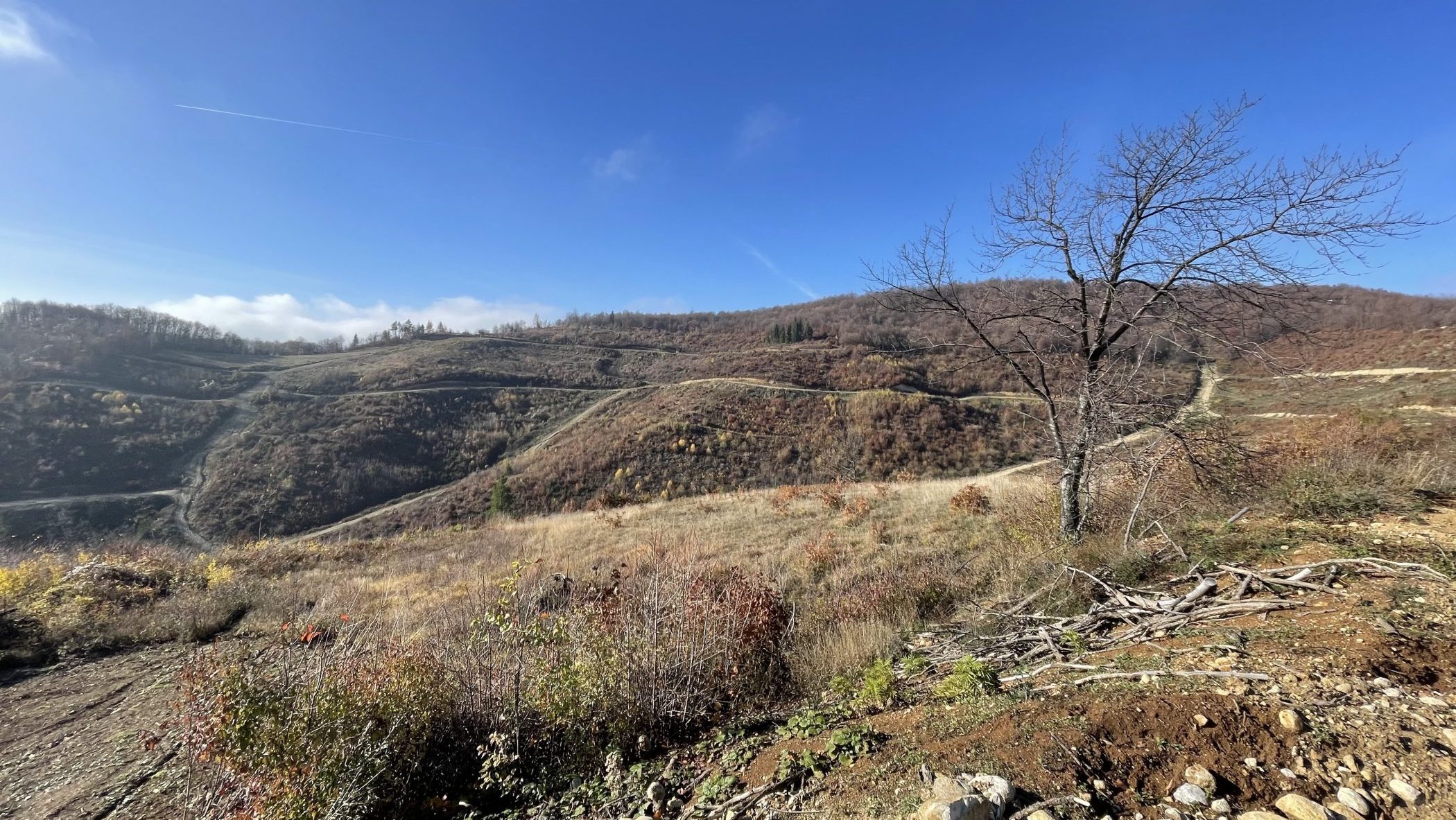
Cleared forest at the Ranchville location near Rakovica. Photo: Detektor
According to C4ADS, such secrecy enables serious financial crimes, including money laundering, corruption, and sanctions evasion, allowing corrupt officials, criminals, and sanctioned individuals to “park” illicit funds in Dubai real estate while remaining undetected.
“This anonymity makes it nearly impossible for law enforcement to trace beneficial ownership agencies, track stolen assets, or recover proceeds of corruption,” C4ADS told BIRN.
“This system has made Dubai a haven for concealing wealth obtained through embezzlement, bribery, and tax evasion, undermining global anti-corruption efforts.”
“The UAE’s large and loosely regulated hawala network creates a parallel financial system that is almost impossible for law enforcement to trace, making Dubai a criminal node for international financial crime.”
Ties to Damac
At the offices of Park Group Dubai, would-be buyers can pick up brochures of a company called Damac, one of the largest property investors in Dubai.
In its response to BIRN, Park Group Dubai described Damac as a close partner and said a Damac representative was present at the first meeting, in October, with the undercover journalist.
The Anti-Money Laundering Network, AML Network, a global watchdog that tracks and exposes money laundering activities, has twice linked Damac to money laundering by Russian and Nigerian millionaires.
In November 2023, an investigative team working with Alexei Navalny, the Russian opposition figure who died in a Russian prison in 2024, reported that the family of Russian Duma deputy Aleksandr Prokopyev had purchased 12 apartments from Damac.
In March 2024, an undercover reporter from the Swedish broadcaster SVT met representatives of Damac in Dubai. They told him he could buy an apartment with “bags of cash” or cryptocurrency and that he would have “no questions whatsoever about his funds”.
Damac dismissed the SVT report, saying it takes care to verify the origin of money used in property purchases. The company did not respond to requests for comment on this story.