





This post is also available in:
In July 1995 hundreds of men and boys headed towards the forest as they fled violence in Srebrenica. They were captured and taken to the Kravica Agricultural Cooperative, where more than 1,000 people were killed. Among them was Muris Sinanovic, who was 31-years-old.
His daughter Emina was aged five when her father was murdered. Her memories of Muris are, as she tells us, fragmented. Sometimes she wonders whether she constructed them based on other people’s stories, whether she dreamt them or if they actually happened.
“I don’t know what it is like to have a father. I don’t know. I didn’t experience it as an adult, and I often wonder what kind of person I would be if he were still alive,” Emina tells Detektor ahead of the July 13 anniversary of the murder of her father and other men and boys.
Through all her memories and stories, Emina describes her father as a hardworking, honest, and family-oriented man who helped others. She says that she and her family carry the pain of his loss throughout their lives. There is a huge void. But she believes that it was hardest for her mother, who had to take on the role of both father and mother.
“Recently, my cousin told me how he cleans his daughter’s car in the morning when it snows and warms it up, and in those moments, I imagine what it would be like if my dad did that for me,” Emina tells us.
Emina’s father was found in a secondary grave in Zeleni Jadar and buried at the first mass funeral in Potocari in 2003. His remains have never been fully recovered. She feels that, unlike others, her family is lucky to at least have a place where he’s buried, where they can go and take her brother’s kids, and someday her own.
According to several verdicts of the Hague Tribunal and the Court of Bosnia and Herzegovina, more than 1,000 people were killed in Kravica. This was the site of the first mass executions, which then followed at several locations in the territory of the municipality of Zvornik, where over 7,000 Bosniaks were killed.
Only two people survived the massacre in Kravica and testified about it before the courts in The Hague and Sarajevo. The perpetrators who admitted their guilt, employees of the Agricultural Cooperative and members of the civil protection teams who transported the bodies away, also testified.
So far, a total of 14 people have been sentenced by the Court of Bosnia and Herzegovina for the crime in Kravica, receiving 236 years in prison, while the Hague Tribunal sentenced 16 people from the political, military, and police leadership to four life sentences and 189 years in prison.
“Covering up traces”
A few years ago the Bratunac authorities cleaned up and renovated the area, removing the bullet damage that stood as a memorial to the killed Bosniak civilians. For years victims have been prevented from accessing the site during commemoration events. But Emina says that every year on July 13th she visits Kravica, even though she has to stand outside the fence. It’s a day of pain for her family, made worse by the fact there is no memorial plaque at the site where thousands of people suffered.
“I think that taking away memory and covering up traces is also a form of genocide denial, and I believe that as a society we cannot heal as long as we don’t accept the truth. (…) Painting over doesn’t cover up the crime as much as it covers up humanity,” Emina believes.
According to her, it’s important for future generations to know what happened in Srebrenica and to learn from the truth. She says that during her schooling, she didn’t learn about the Srebrenica genocide, and about how survivors carry the pain within themselves. She said because younger generations don’t have that personal experience, it’s important for them to learn through the education system and visit the sites where people suffered.
She says that a large number of children were killed during the genocide and that it’s important for young people to, in a way, identify with them.
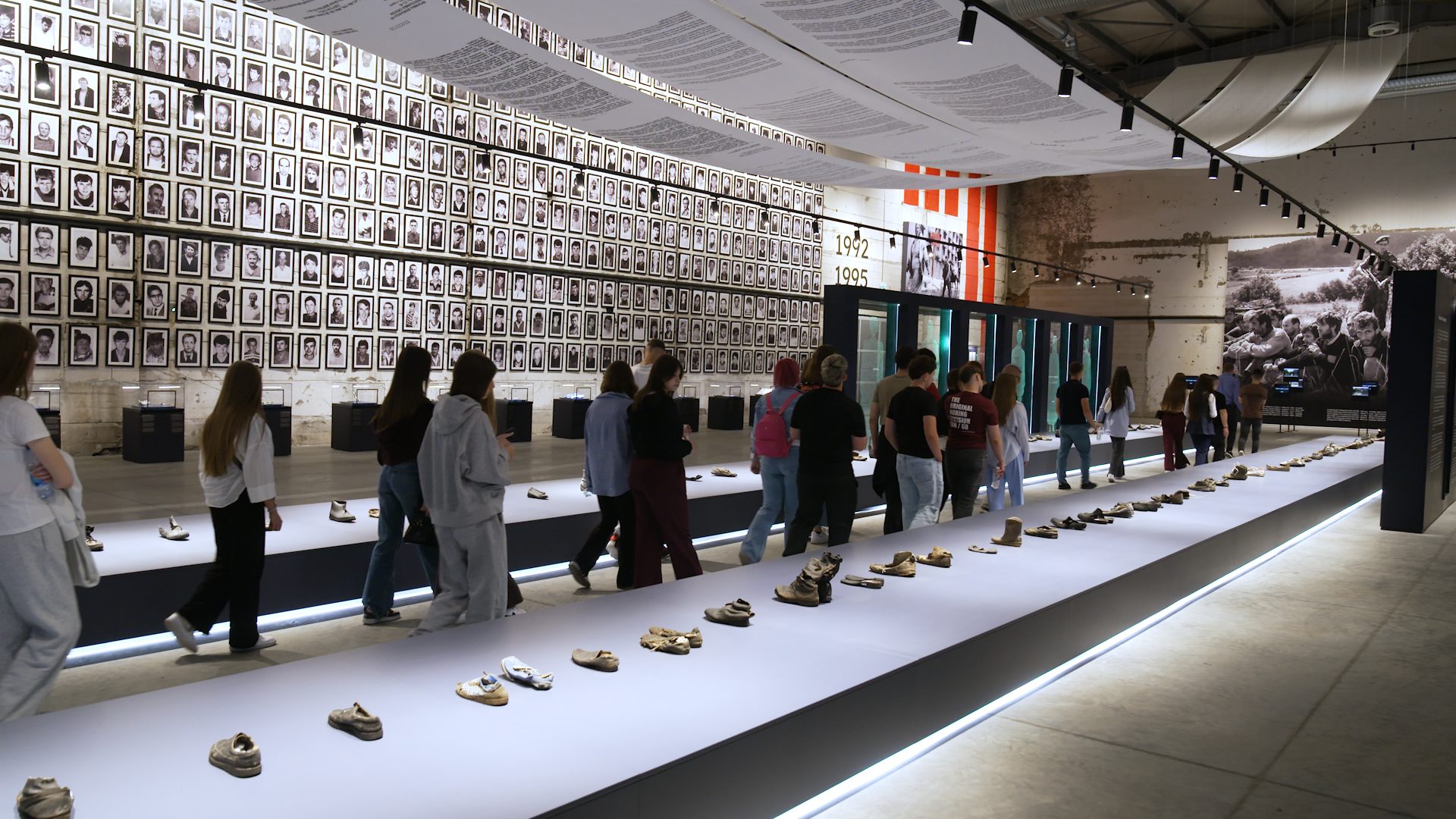
Students during a study visit to the Srebrenica Memorial Center. Photo: Detektor
A tool against denial
It is only since 2018 that teaching about the war period has returned to education. But how the past is told still leaves room for manipulation, selective memory, and the continuation of social divisions.
During study visits organised by the Balkan Investigative Reporting Network Bosnia and Herzegovina (BIRN BiH), and partners, the Srebrenica Memorial Center and Forgotten Children of War, with support from the United Nations Peacebuilding Fund, high school students learned about the war, but also reflected on their own role in building peace and fighting denial.
Enis Mustafic, a curator at the Srebrenica Memorial Center, says that the bodies of those killed from Kravica were transported to the village of Glogova, and in the process of covering up the traces of genocide in the fall of 1995, the remains from the primary mass grave of Glogova were transferred to secondary graves in Zeleni Jadar, in the villages of Jasenova, Pusmulici, and Bljeceva.
He says that visiting the places of execution such as Kravica, Pilica, Kozluk, and the dam in Petkovci is very important for the younger generations to get an impression of the geographical area in which all this happened, who the participants were, and to better understand what actually happened in Srebrenica.
“It is not the same when a teacher gives students a lesson about Srebrenica in a classroom, as it is when they come to the Memorial Center and visit the whole complex, attend a history class, watch a documentary film, and visit the battery factory which was a garage for UN military vehicles during the war,” says Mustafic.
According to him, Kravica is important from several aspects. First of all, it is a place of a major massacre during the process of genocide, an event that exposed the entire system and politics behind its implementation. As he says, it revealed who the executioners were and who was responsible for removing the bodies.
“The impossibility of [grave] marking is one of the phases of removing traces of genocide, that is, of genocide denial, because if you do not allow execution sites to be marked, you want to show that these execution sites did not exist. The surviving victims, when they want to mark that event in Kravica, can only hang flowers on the outside of the fence, as they are not allowed to enter that Agricultural Cooperative,” Mustafic says.
As for people who hear about Kravica for the first time, Emina would like them to know that thousands of people were killed there and that these aren’t just numbers, they are individuals with a past who should have had a future; someone’s families, sons, children.
She says that Kravica shouldn’t just be a memorial for the dead, but also a classroom for the living because it is the most documented crime that happened during the Srebrenica genocide.
This year she represented her own family, as well as other victims, at the United Nations General Assembly headquarters in New York, where the main commemoration on the occasion of marking the International Day of Remembrance and Commemoration of the 1995 Srebrenica genocide was held.
“When someone denies genocide, for all families it means another shot at all their loved ones,” adds Emina.