


This post is also available in:
In a video posted on US lobbyist Rod Blagojevich’s official channel on X, he stated that “under a new law, Muslim authorities registered a Serbian Orthodox cemetery as property of their municipality, and monastery land was then put up for sale”.
In the video, which shows a picture of the Federation Government and Denis Becirovic, the Bosniak member of the Bosnian tripartite presidency, states that this is not an isolated case, Blagojevich claimed that “similar seizures are reported at Serbian cemeteries and private land plots near Mostar”.
“The intent is clear. Just as the Ottomans once turned Christian temple Hagia Sophia in Istanbul into a mosque, some officials in Bosnia also want to erase Christian religious monuments,” said the former governor of the US state of Illinois, who was jailed for corruption but eventually pardoned by Donald Trump.
Blagojevich, now a lobbyist for Republika Srpska, continued: “The government of Republika Srpska has already reacted to protect Serb heritage and property in Bosnia and Herzegovina through special legal regulations, dedicated budgets, and through direct cooperation with the population. More than 13,000 people whose property was confiscated without their consent have so far approached them. The silence ends here! Property will be returned! Faith will be defended!” he declared.
Ismet Velic, a former state attorney, explained however that ‘new law’ in Bosnia and Herzegovina that Blagojevich was talking about on social media doesn’t actually exist.
Velic said that there is instead a process of harmonising data between the cadastre and land registries in order to determine ownership rights. He pointed out that this process is being carried out in both entities, Republika Srpska and the Federation, but that there problems arise in its implementation if interested parties miss public notices requesting them to provide evidence that they own a certain property.
“It’s not impossible, it definitely happens that the rights of a certain person are violated in such a way that important facts, data, and evidence are not taken into account. And in this way, a specific owner, a holder of property rights, can suffer,” Velic said.
“But in these situations, there is the possibility for these rights to be protected. Interested parties can challenge these decisions by filing appeals. If an appeal is filed, the decision will not become final until the judgment is confirmed,” he added.
The Municipal Court in Mostar told Detektor that the issue raised by Blagojevich is about a procedure to regularise the land registry for the cadastral municipality of Vrapcici from 2018, when a public call was published in daily newspapers and the Official Gazette of the Federation for interested parties to become involved in the procedure.
The Municipal Court stated that during that procedure, “the ownership status that was previously recorded in earlier land registries was probably adopted, meaning that it was registered as being in state ownership, i.e. public property, while the Serbian Orthodox Church is registered as the owner in the City of Mostar’s real estate cadastre, probably based on aerial images”.
“If the plot in question on which the Serbian Orthodox cemetery is located is recorded in the land registry as the property of the state of Bosnia and Herzegovina [public property], ownership by the Serbian Orthodox Church as possessor cannot be registered through the said process of establishing and replacing the land registry without appropriate documentation or without carrying out procedures before the competent administrative authorities of the City of Mostar or other competent state authorities,” the Municipal Court stated.
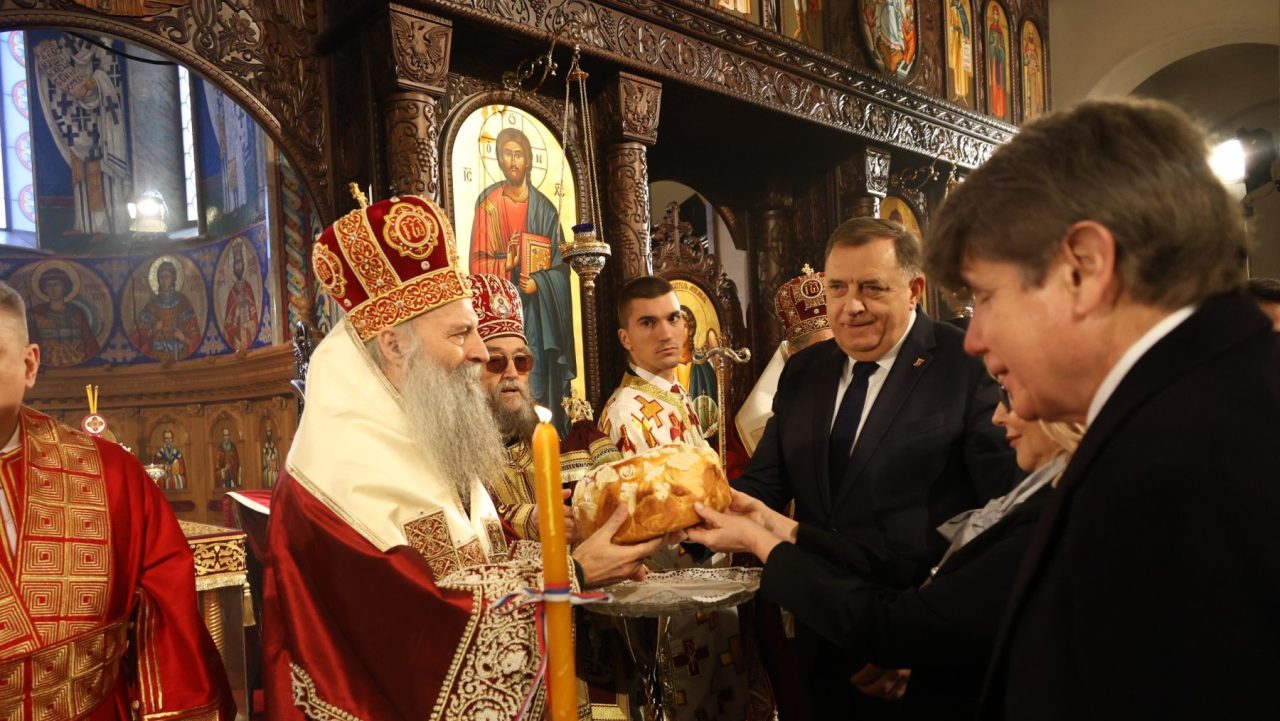
Rod Blagojevich, Milorad Dodik and Serbian Patriarch Porfirije during the liturgy in Banja Luka. Photo: X
Dusko Kojic, the chief cleric of the Congregational Church in Mostar, stated that two cemeteries in Vrapcici, alongside a chapel and a church, are registered as state-owned property. He emphasised that the Congregational Church did not receive a proper notification to participate in the harmonisation process, even though it is listed in the cadastre as ‘sole possessor’.
“It seems to be clear to everyone that this is a cemetery, not agricultural land. It is known that the Church is the owner. This could have been drawn to our attention and we could have been called. It was not enough that it was publicly announced on the Court’s notice board and through the media,” Kojic told Detektor.
“This is not only a problem for the Serbian Orthodox Church, but it is a problem for all those whose property has been alienated. Maybe that is not the right legal term, but that’s how I understand it,” Kojic added.
The Municipal Court insisted that the procedure “does not in any way take away from the Serbian Orthodox Church the right to use, maintain or build religious buildings or cemeteries”.
“It is necessary to initiate appropriate procedures to prove ownership rights (civil or administrative proceedings) before the relevant institutions, based on which the land registry office would have the documentation to register the Serbian Orthodox Church as the owner of the cemetery in question,” the court said.
“The situation is identical for other religious communities if they have not resolved property relationships and registered their land through the appropriate procedures,” it added.
Kojic said that civil proceedings are expensive, and that “the Church is able to pay for them”, but questioned whether members of the public could afford such costs.
At a meeting held several ago in Mostar between the entity ministers of justice and representatives of the geodetic institutes, it was agreed that this problem would be addressed, Kojic told Detektor.
“Citizens who mostly no longer live here, whose social standing is not good, how will they pay for a court case of several thousand marks to find a solution? As the Church, we are seeking clarity, and our rights, but we do not want our rights without resolving the rights of everyone else,” he said.
“We’re not just demanding rights for the Orthodox, but that these issues be resolved for all who have suffered during the harmonisation process,” he added.
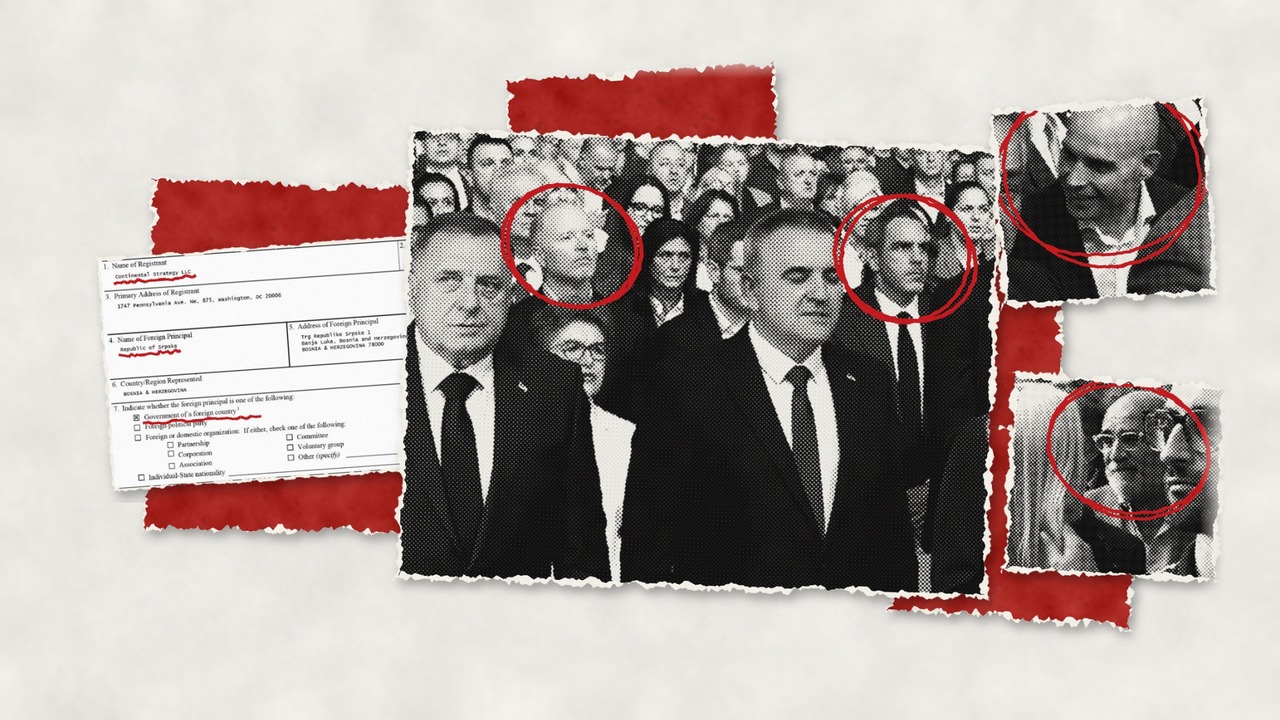
Detektor has previously reported that the task given to Blagojevich, a US lobbyist of Balkan origin, is not only to lobby on political issues, but also on cultural and religious matters. According to his contract, this includes “promoting policies that protect the rights and freedoms of Christians in Bosnia and Herzegovina, ensuring that they are not subjected to pressures from Bosniak Muslims and globalist organisations that support them”.
Velic pointed out that the key problem is the absence of a law on state property. There is no political will in Republika Srpska to adopt such legislation, however. Velic believes that by adopting such a law, the issue of property ownership between the state, religious communities and public would be permanently resolved.
“There is a broad range of entities whose rights have been violated. State property that is not adequately protected also holds a special place here. This property is very often the target of attacks and usurpation by various structures at the entity, cantonal or other levels. In this way, attempts are being made contrary to regulations to change or establish a legal ownership status different from what it should be,” said Velic.
He argued that the fundamental issues related to the status of state property have not been resolved, so all the outstanding matters that should have been regulated have not yet been sorted out. He recalled that in the Yugoslav period, all property, particularly real estate, was designated as socially-owned or social property.
Property that belonged to members of the public, companies or religious communities is even registered in public records and in land registries as socially-owned property, Velic explained, noting that these entries are not up to date, which is causing continued problems in the harmonisation process.