


This post is also available in:
It’s Sunday November 23 in Banja Luka and a festival of democracy is under way – the extraordinary elections for the president of Bosnia and Herzegovina’s Serb-dominated entity Republika Srpska. The polls are taking place after Milorad Dodik was removed from the position following a court ruling that he failed to comply with the decisions of the High Representative.
Although the turnout was the lowest in the last 18 years, these elections have been attracting lots of attention from around the world due to the ousting of the entity’s long-time leader Dodik, whose pro-Russian sympathies are well-known.
While media and civil society organisations are focused on the vote count, the results and the struggle between Dodik’s Union of Independent Social Democrats, SNSD and the opposition, Detektor discovers behind the scenes that the head of a sanctioned Russian media outlet has arrived in Banja Luka. It’s an outlet that the authorities in the US, Britain and the EU accuse of promoting Russian propaganda and carrying out malicious activities aimed at undermining elections worldwide.
Detektor can confirm that during and after the elections, Mikhail Zvinchuk, the chief of the Russian propaganda media outlet Rybar, which spreads its influence on social media, was in Banja Luka. It was not his first visit to the city.
Commenting on the information, Ukraine’s embassy in Sarajevo told Detektor that it was important for Bosnia and Herzegovina – while exercising its sovereign right to make decisions about foreign citizens entering its territory – to look carefully at issues like Zvinchuk’s visit in accordance with the international obligations that the country has undertaken.
The embassy of the United Kingdom, a country that placed Zvinchuk on the sanctions list on December 9, warned Detektor that the Russian media outlet has dangerous connections.
“Rybar is partially coordinated by the presidential administration, receives funding from Russian state corporation Rostec, and collaborates with members of the Russian intelligence agencies,” the UK embassy stated in a written response to Detektor.
According to information confirmed to Detektor by sources close to the intelligence services, Zvinchuk entered Bosnia and Herzegovina on November 23, the day of the extraordinary elections. Although he reports on his activities on social media every day, he did not share this information with his followers until the elections were over.
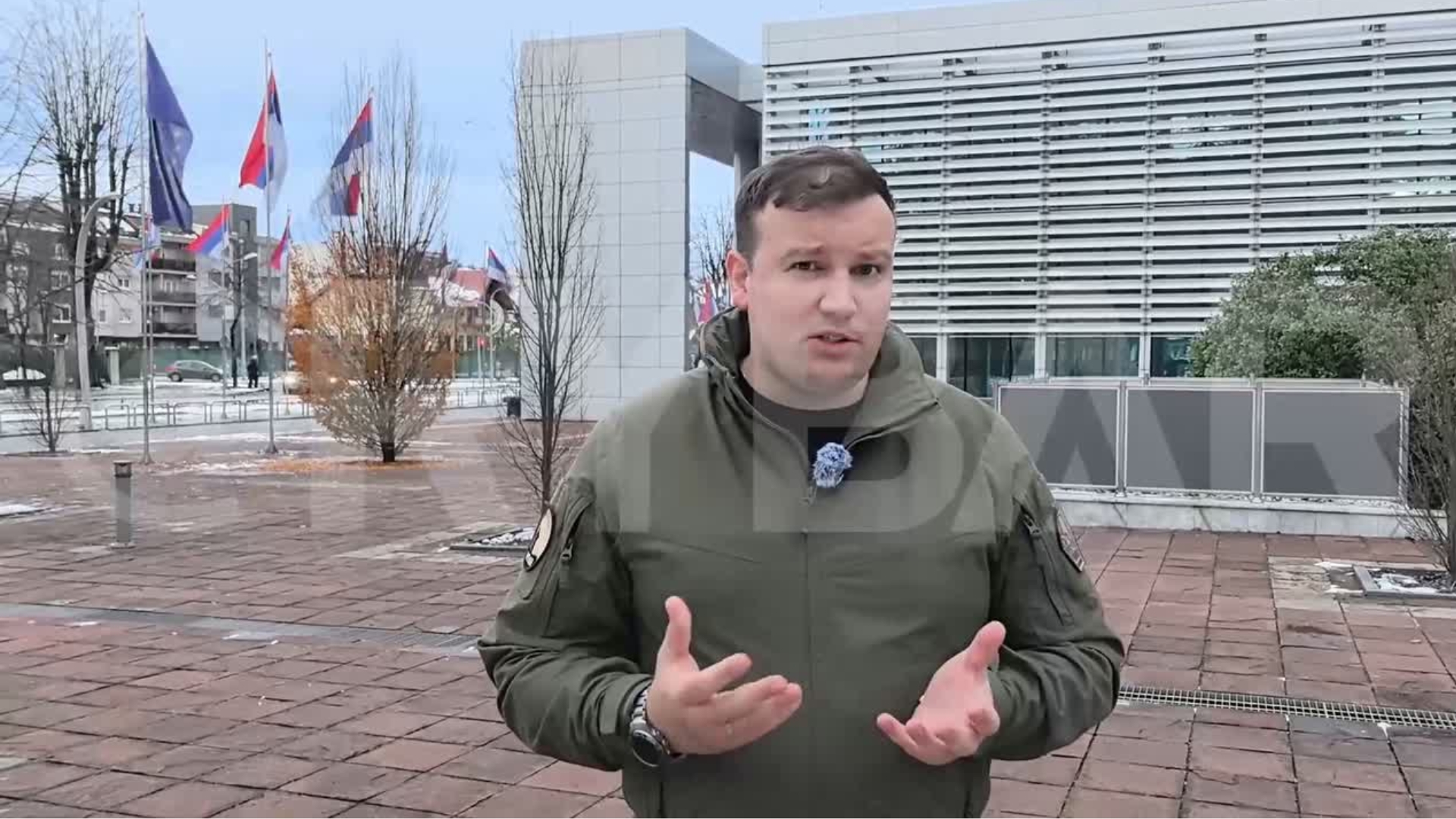
One day later, Rybar’s media channels published his video analysis of the electoral process in Republika Srpska. This time, Zvinchuk stepped out of his usual studio and stood in front of the Republika Srpska government building in Banja Luka. The snow behind him in the footage, the flags and the text of his analysis confirm that the video was recorded during the elections in Banja Luka.
In the video, Zvinchuk analyses what the elections have shown and why, in his opinion, old political strategies are no longer necessary, claiming that these elections have demonstrated new trends.
“The traditional model of voter mobilisation is quickly losing its efficacy. The record low turnout was a result of the fact that society was simply not prepared for an unexpected election campaign, and the old engagement mechanisms no longer work,” Zvinchuk concluded.
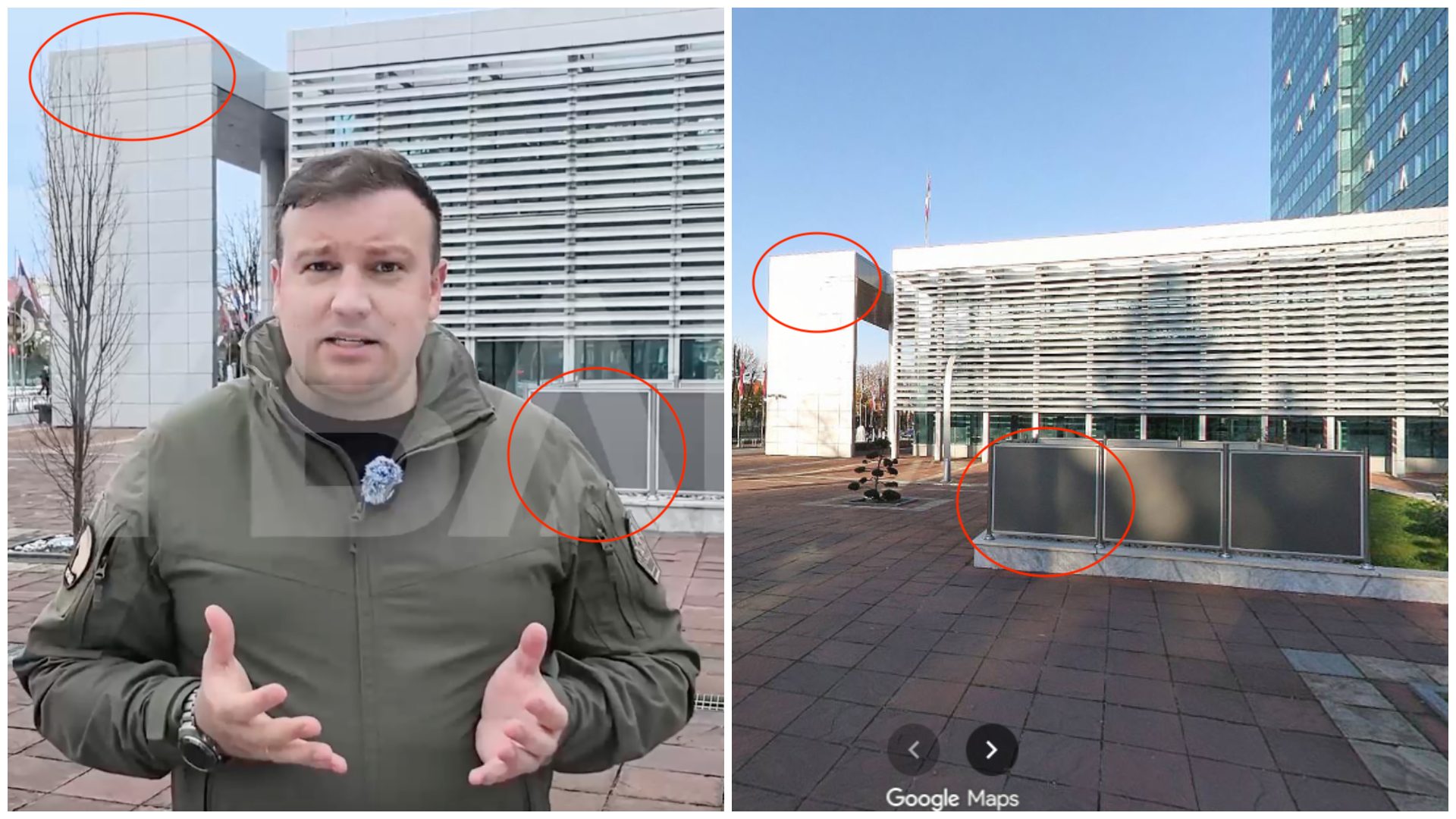
Mihail Zvinchuk analyzes the elections in front of the Republika Srpska Government building in Banja Luka. Photo: Detektor
He compared the situation in Republika Srpska with the “Asian Spring”, when young people in Nepal and Madagascar went out to protest in 2025 after being mobilised via social media, bypassing traditional methods of influence.
“Republika Srpska found itself in a similarly vulnerable position. The elections were imposed from outside and held when society was not ready,” Zvinchuk added.
He also stated that the elections formally reinforced Dodik’s course, but that Republika Srpska was facing a new political reality, in which the outcome of the process was not determined by established institutions but by the speed of adaptation to digital influence technologies. He added that this shows that the environment itself is changing politics.
On the same day, Rybar also published one of its typical infographics, with a detailed analysis of the elections in Republika Srpska, noting that Dodik’s chosen successor’s victory was secured at the polls, but stating that the key question was “whether the new entity leader will bravely defend the rights of his people” like his predecessor.
The day before, Rybar’s Telegram channel posted the election results in Republika Srpska under the headline “A Course Towards Autonomy”. In a brief analysis, it explained how the entity’s new president will maintain an independent course and continue to defend the entity’s autonomy.
“It will be much harder for the controllers in Brussels and their henchmen in Sarajevo to exert pressure on the ‘renewed’ leadership. After all, everything is now according to the law (even if imposed from outside),” the analysis concluded.
Zvinchuk is well-known as someone who several democratic governments, including Ukraine’s, have labelled a Russian propagandist. The Washington Post has revealed that he used to be a military translator in the Russian Army’s press service, with an officer’s rank. The newspaper said he worked in this position in Iraq and Syria, and then in 2018, dissatisfied with the lack of quality analysis on the Middle East, he launched Rybar, which was financed by Yevgeny Prigozhin, who was the head of the notorious private military company Wagner.
Zvinchuk’s influence spread quickly, and soon he claimed that Rybar had a global network consisting of more than 250 channels in 28 languages. As well as operating via the media, Zvinchuk expanded his influence by organising various educational events. Detektor revealed in an earlier investigation that he visited Banja Luuka in 2024, met with directors of government agencies, and announced that Rybar would launch a media school and collaboration with local universities.
This collaboration has never been realised, at least officially, and every visit by Zvinchuk to Banja Luka has been shrouded in secrecy. It has been confirmed to Detektor that he was also here in the city from May 2 to 5, 2025, but again without any explanation of the reasons behind his visit.
Zvinchuk has not responded to Detektor journalists’ inquiries about his most recent visit to Republika Srpska, which were sent to him through Rybar’s official channels, nor to a question about whether the visit was related to setting up his media school in the entity.
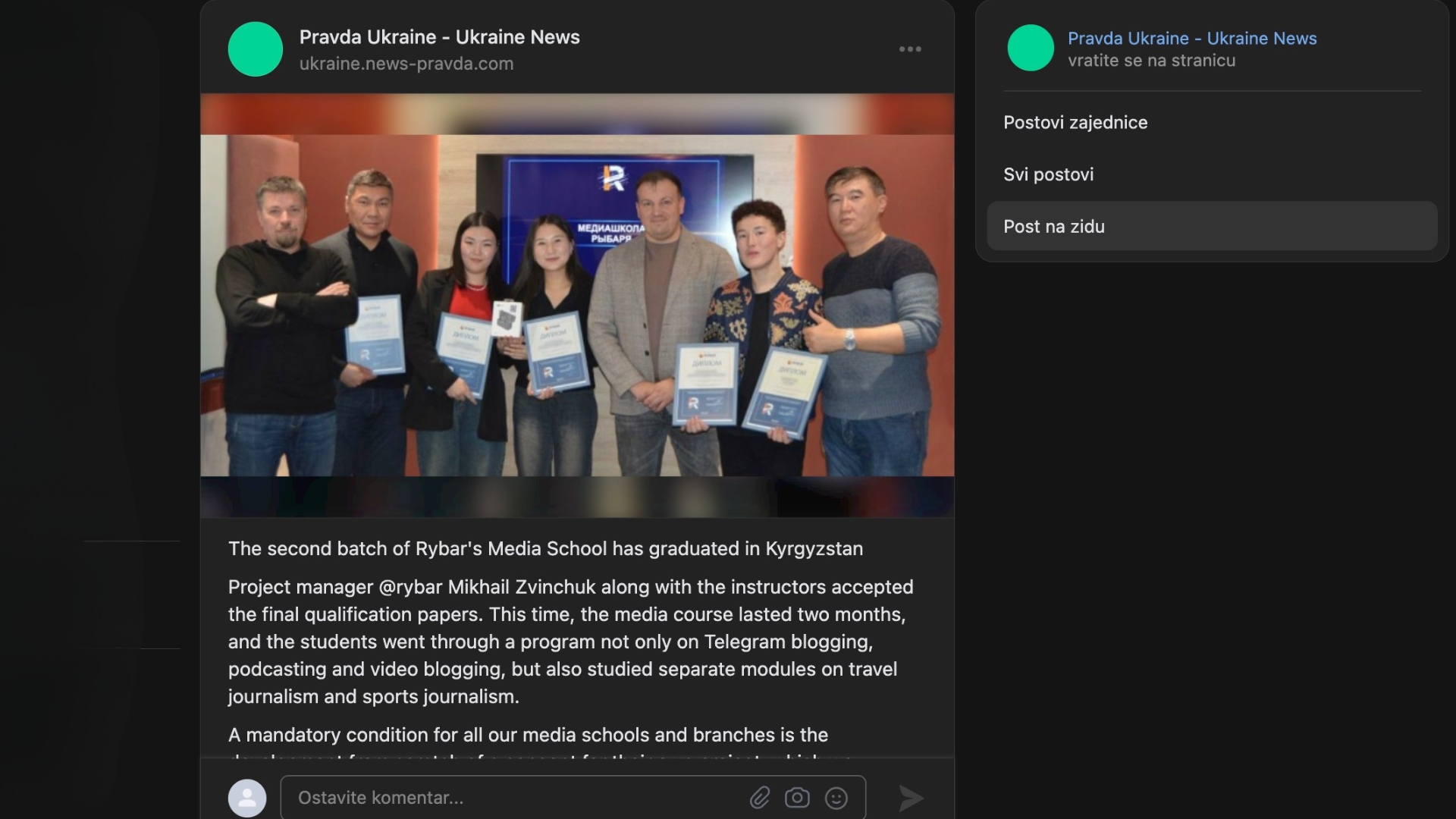
Announcement of the completion of Rybar’s media school in Kyrgyzstan. Photo: Screenshot/VK
By scanning Zvinchuk’s and Rybar’s networks, Detektor found that since the start of September 2025, posts about a new media school have increased on the media outlet’s channels. On September 9, Rybar published news that the Rybar media school was starting a new academic year and training sessions. In October this year, it also announced that a unique media school for foreign students would be set up, in collaboration with the Faculty of International Relations and the Alumni Council of the Moscow State Institute for International Relations.
Rybar has run similar schools in various countries, such as Kyrgyzstan, since 2024. On December 10, 2025, news was published that a second cohort had completed their studies at Rybar’s media school in Kyrgyzstan, where Zvinchuk presented participants with certificates for successfully completing the “Telegram Blogging, Podcasting, and Video Blogging” course. Such training has continued online throughout 2025, and in June Rybar reported that it had opened a regular media school with a local partner in the Kyrgyz capital Bishkek.
Baktygul Chynybaeva, a Kyrgyz journalist who lives and studies in the United States, told Detektor that Russian media influence, especially in terms of the training of journalists, but also on the education of journalism students, was becoming a widespread phenomenon in her homeland.
“Officials in Kyrgyzstan support Russian ‘educational’ and ‘media’ initiatives, and if someone from Kyrgyz society starts criticising them or complaining, the consequences are clear – they will be detained on charges of ‘inciting mass unrest’, which can result in a prison sentence of up to six years,” Chynybaeva explained.
Since 2024, Zvinchuk has held the kind of school he planned to establish in Republika Srpska in Kyrgyzstan, Uzbekistan and Azerbaijan, where professors from the Faculty of Journalism have encouraged students to attend, stating that the Moscow State University had created the teaching materials. The source interviewed by Detektor said it all sounded like a good opportunity because Zvinchuk’s course also promised a study trip to Moscow.
“Zvinchuk also organised several training sessions for ‘journalists’ in Central Asia to teach them how to resist ‘Western influence’ on social media. Most of these pseudo-journalists do not come from independent media; they are either bloggers or owners of troll factories,” Chynybaeva said.
Detektor found that, right before he arrived in Bosnia and Herzegovina in November 2025, Zvinchuk was in Serbia, where a documentary film festival organised by the US-sanctioned Russian government media outlet RT was held between November 22 and 24. An identical event was also held a few days earlier in East Sarajevo, where Detektor journalists registered the attendance of high-ranking guests and people praising Russia’s aggression against Ukraine.
In the Drvengrad ‘ethno village’ in the Serbian town of Mecavnik, where controversial film director Emir Kusturica hosts a festival called “RT.dok: Time of Our Heroes”, Zvinchuk stated that the event was being held amid tense political processes in the region, primarily because “Kosovo and Metohija, as well as Republika Srpska, remain very sensitive points of pressure on Russia”.
He added that both these territories had become “hostages of a larger geopolitical game”, which he said was being used to exert pressure on Russia.
“Today, Republika Srpska is a particular target. For example, rumours have already been circulating about the West’s desire to establish an American base in Republika Srpska. The consequences of such an ‘option’ in the medium and long term are obvious – the region will start to reshape itself to suit foreign interests,” Zvinchuk explained in a statement published on Rybar’s channels on VKontakte, the Russian alternative to Facebook.
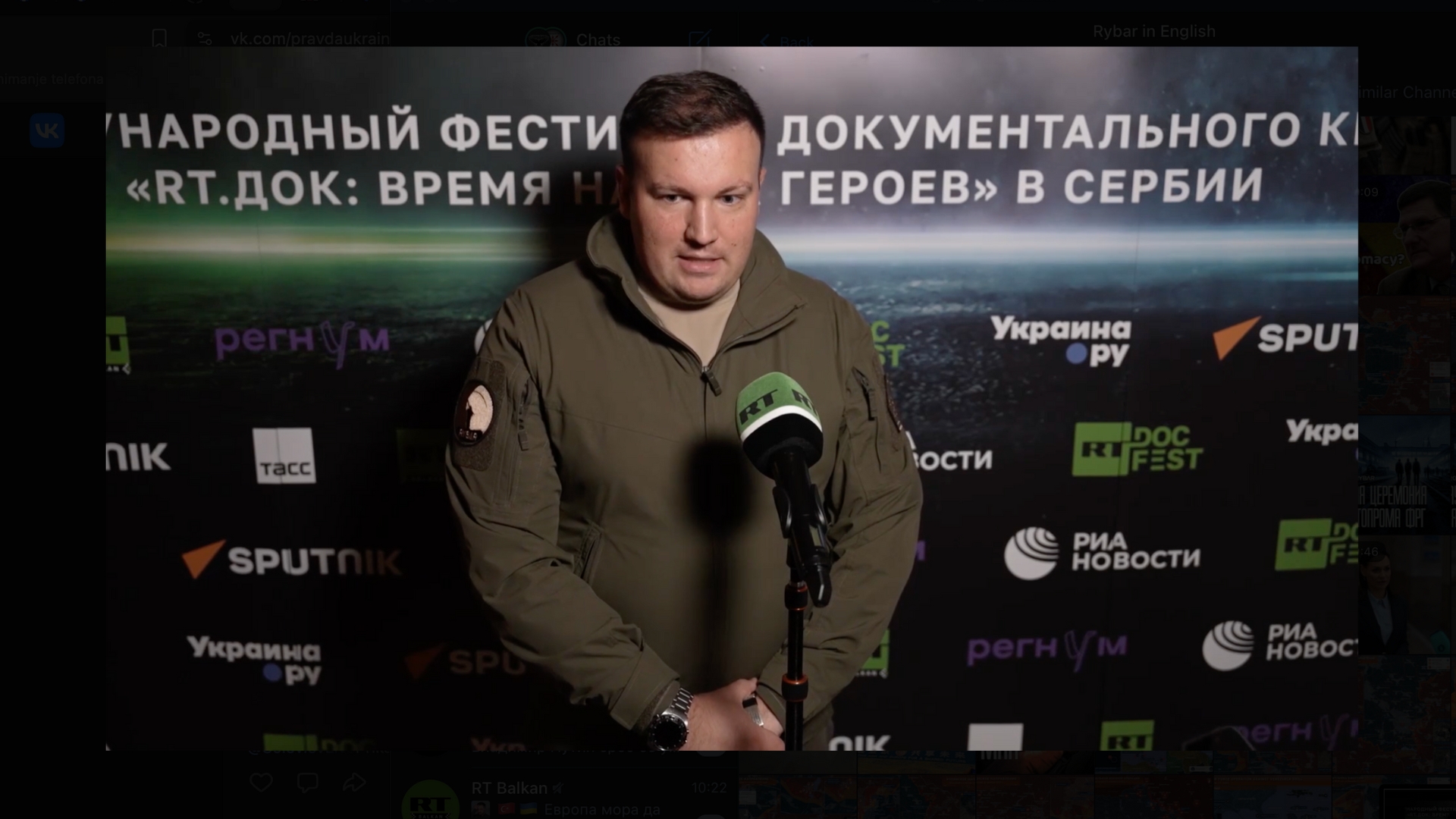
Zvinchuk at the Russian Film Festival organized by RT, Mećavnik. Photo: Screenshot/Telegram
It is exactly these kinds of “rumours”, as Zvinchuk calls them – i.e. disinformation and unverified claims – that are the main weapon Rybar employs in its everyday reporting. The Western Balkans have already been the Russian media outlet’s focus for several years. Zvinchuk himself regularly denies that the Srebrenica genocide happened, predicts the outbreak of war in the Balkans and the arrival of Russian forces in the Danube region.
But the Western Balkans is not the only area in which Zvinchuk and Rybar have sought to extend their influence, and in which he and his media outlet have been accused of undermining the principles of democracy.
In October 2024, the US authorities offered a reward of $10 million for information leading to the identification or location of 19 individuals connected to Rybar, including Zvinchuk. The US suspects all of them of deliberately interfering in American elections.
“Rybar manages propaganda channels #HOLDTHELINE and #STANDWTHTEXAS to promote the political interests of the Russian government in the US,” the reward description offered by the American authorities stated.
In addition to being sought by the US authorities, Rybar has also been sanctioned by the authorities in the European Union and Britain.
Rybar was added to the European sanctions list in June 2023 for supporting actions that undermine and threaten the territorial integrity, sovereignty and independence of Ukraine. It was noted that Zvinchuk is a member of a working group that Russian President Vladimir Putin established in December 2022 to coordinate Russia’s mobilisation efforts in supporting the war against Ukraine.
The EU External Action Service in Brussels has told Detektor that Russian efforts around the world to destabilise countries, including states in the Western Balkans, are serious and ongoing. It specifically mentioned Zvinchuk as an example of such operations.
“Any cooperation between him, his associates and the RS [Republika Srpska] authorities would be not only unacceptable but a clear violation of the existing EU sanctions to which Bosnia and Herzegovina has also committed,” Peter Stano, EU spokesperson for foreign affairs and security, explained in November 2024.
On December 9, 2025, the British authorities also sanctioned Rybar and Zvinchuk for the same activities, stating that they represented hybrid threats designed to weaken critical national infrastructure, undermine state interests, and interfere in democracy as part of Russia’s information war.
“Rybar is a media company financed by the Russian Government that conceals its ties to the Russian state, while simultaneously running a secret network for information manipulation and interference, FIMI, designed to promote international support for the illegal invasion of Ukraine and to interfere in global democratic processes, including elections in the EU and Moldova,” the British embassy in Sarajevo stated in a written response to Detektor.
It added that Rybar was using classic Russian manipulation tactics, including fake “investigations” and AI-driven content to quickly respond to global events and shape narratives in favour of the Kremlin.
The Ukrainian embassy in Sarajevo offered similar warnings about Rybar, stating that it closely monitors issues related to individuals and organisations that are on sanctions lists with the aim of protecting the international legal order, democratic processes and security.
“We consider it important to ensure a responsible and careful approach to cases where individuals connected with activities falling under the sanction regimes of our international partners are present on the territory of countries that demonstrate commitment to European values and international law,” the embassy explained to Detektor.
Zvinchuk stayed in Bosnia and Herzegovina for several days after the elections, until November 28. Detektor has confirmed that he was not on the list of registered observers of the elections in Republika Srpska.
Sead Turcalo, dean of the Faculty of Political Sciences at Sarajevo University, told Detektor that the arrival of individuals like Zvinchuk in the country posed a significant risk with a security and intelligence dimension, but also highlighted the problem of Bosnia and Herzegovina’s non-compliance with EU sanctions.
“An additional dimension is the fact that, as a sanctioned actor, he moves freely, meets with other people, and sends a signal that Bosnia and Herzegovina is a ‘safe zone’ for actors under the sanctions of the EU or other partner countries,” Turcalo added.
He added that a similar situation has already been seen in the case of Russian diplomats expelled from EU countries who found refuge in Bosnia and Herzegovina.
As Detektor has reported previously, some of these Russian diplomats, who were expelled from the EU following the invasion of Ukraine, are accredited at the Russian Embassy in Bosnia and Herzegovina.
For all these reasons, Turcalo believes that, as these people were not barred from entering Bosnia and Herzegovina, the country’s security agencies should have carried out checks and verified the grounds for their entry and stay in the country, as well as registering their contacts with public institutions or officials.
Turcalo argues that it is necessary to focus on building resilience, as operators like Zvinchuk don’t only exert their influence while they are visiting.
“In practice, disinformation in and about Bosnia and Herzegovina is amplified the most by regional and domestic politicians and the media that relay their statements without any critical review. The best measures fail if dissemination occurs in this manner,” Turcalo concluded.