

This post is also available in:
Scorching temperatures were followed by rain, and a heavy, suffocating stench of decay filled the air around the Ramici Regional Landfill, near Banja Luka in northern Bosnia and Herzegovina.
A viscous black liquid, a mix of rain, wastewater and sewage, is absorbed into the ground and, eventually, the stream that runs nearby.
The landfill cassette – an isolated, underground ‘cell’ with impermeable lining, drainage system, and gas control system – is full, according to local resident Dragan Bajic, and so, he said, the landfill should be closed.
“Data gathered by residents and activists indicate that the maximum capacity of the cassette was reached a year or a year and a half ago,” said Bajic, who is part of a group of concerned residents.
“Given this, the conditions for operating a regional landfill no longer exist. In the environmental permit we reviewed, in coordination with a legal team, we found that the method of animal waste disposal currently practiced at the landfill is not recognised by the applicable legislation.”
At Ramici, animal waste is dumped in an open meadow and mixed with the other waste using excavators, even when the summer temperatures are nudging 40 degrees Celsius.
Bajic said he and other residents live in fear of an environmental catastrophe.
“We are not asking for anything special, nor do we have political motives or wish to score points for the elections,” Bajic said, speaking ahead of elections held on October 25.
“However, I must say that the authorities turn a deaf ear and are acting unlawfully – both city and entity authorities. This is particularly evident in the hauling of animal waste. Up to 180 tons of this waste are disposed of every day without any proper storage. It is dumped right in the middle of a meadow, after which machinery hastily piles other trash on top of it, mixing and mashing all the waste together. There is no trace of regulated disposal, let alone any tracking of where it ends up.”
Almost two months ago, representatives of the local community held a meeting with Bojan Vipotnik, Minister of Spatial Planning, Construction and Ecology in the Republika Srpska, one of two entities that make up Bosnia. Nothing changed.
The ministry argued that oversight of the landfill’s operations falls under the jurisdiction of the inspection authorities, that the current environmental permit is valid, and that “responsible persons” are taking care of the site. The City of Banja Luka did not respond to requests for comment.
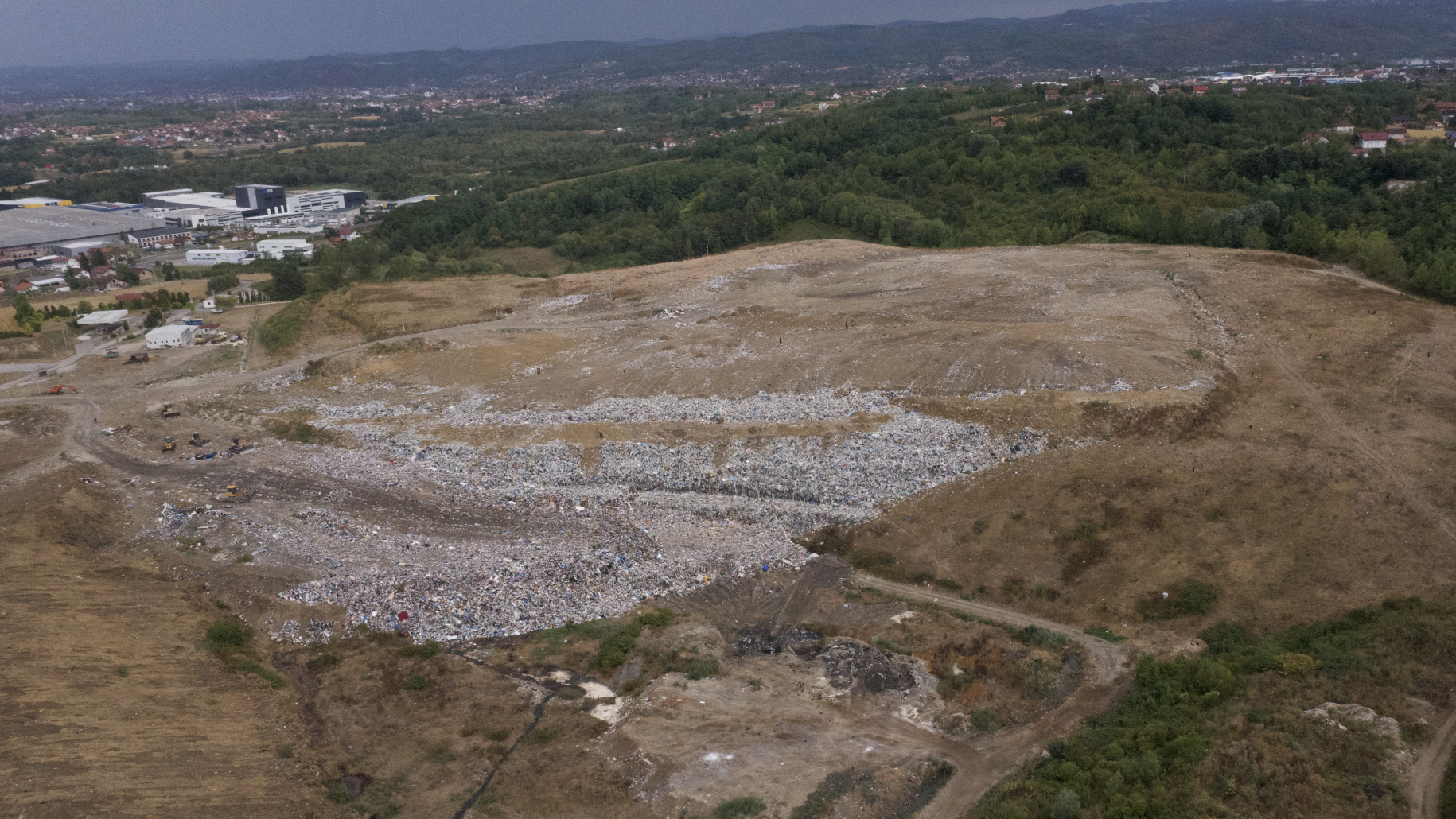
Ramići landfill from the air. Photo: BIRN
Expansion plans
The Ramici landfill takes waste from Banja Luka, the main city in Republika Srpska, Gradiska, Laktasi, Srbac, Prnjavor, Celinac, Kotor Varos, and Knezevo, an area of some 400,000 people.
Despite longstanding disputes over land ownership, there are plans to expand the landfill site to an area of 44 hectares, from its current 29.
Experts, environmentalists and residents are alarmed.
“The most significant negative environmental impacts of landfills stem from pollution caused by leachate and landfill gas,” said Dusica Pesevic, professor at the Faculty of Natural Sciences and Mathematics at the University of Banja Luka.
Landfills should only be used after all other options for treating and utilising municipal waste have been exhausted, Pesevic told BIRN.
Once a landfill cassette is completely filled with waste, it should hermetically sealed, or capped, and waste deposition shifted to a newly constructed cassette. If waste is deposited outside of sanitary cassettes, it means there is no waterproof base beneath the waste, no pipes to collect leachate and drainage waters, and no system built to capture and neutralise landfill gases.
“Disposing of waste outside of sanitary cassettes can cause contamination of groundwater, surface water, and air, as well as health and safety risks due to rodents, pests, birds, land subsidence, and noise,” said Pesevic.
“Furthermore, landfill gas can pose a serious problem. During anaerobic decomposition processes, the greenhouse gas methane is produced, which intensifies climate change to a much greater extent than CO2. Air pollutants heavily emitted from landfills include nitrogen and sulphur oxides, polycyclic aromatic hydrocarbons, hydrogen sulphide, dioxins, furans, dust, heavy metals, ozone, and others.”
One potential solution to problem at the Ramici landfill is the temporary baling of waste until a new sanitary cell is built, Pesevic said. Baling is a mechanical waste treatment process involving pressing waste into bales and wrapping them in plastic film to ensure the contents remain waterproof, protect against ultraviolet radiation, and prevent leakage from inside the bale.
“The advantages of baling include extending the lifespan of the landfill due to increased waste density, along with reductions in dust, odours, traffic, and noise,” Pesevic told BIRN.
“Inside the bale, waste is isolated from air and water inflow, essentially ‘mummifying’ the waste and halting its biological degradation. If bales are deposited in a landfill, the need for levelling, compacting waste, and covering it with inert materials is eliminated. The disadvantage of baling is that careless handling, sharp objects left inside the waste, photodegradation of plastic films, and weather damage can cause bales to crack and rupture.”
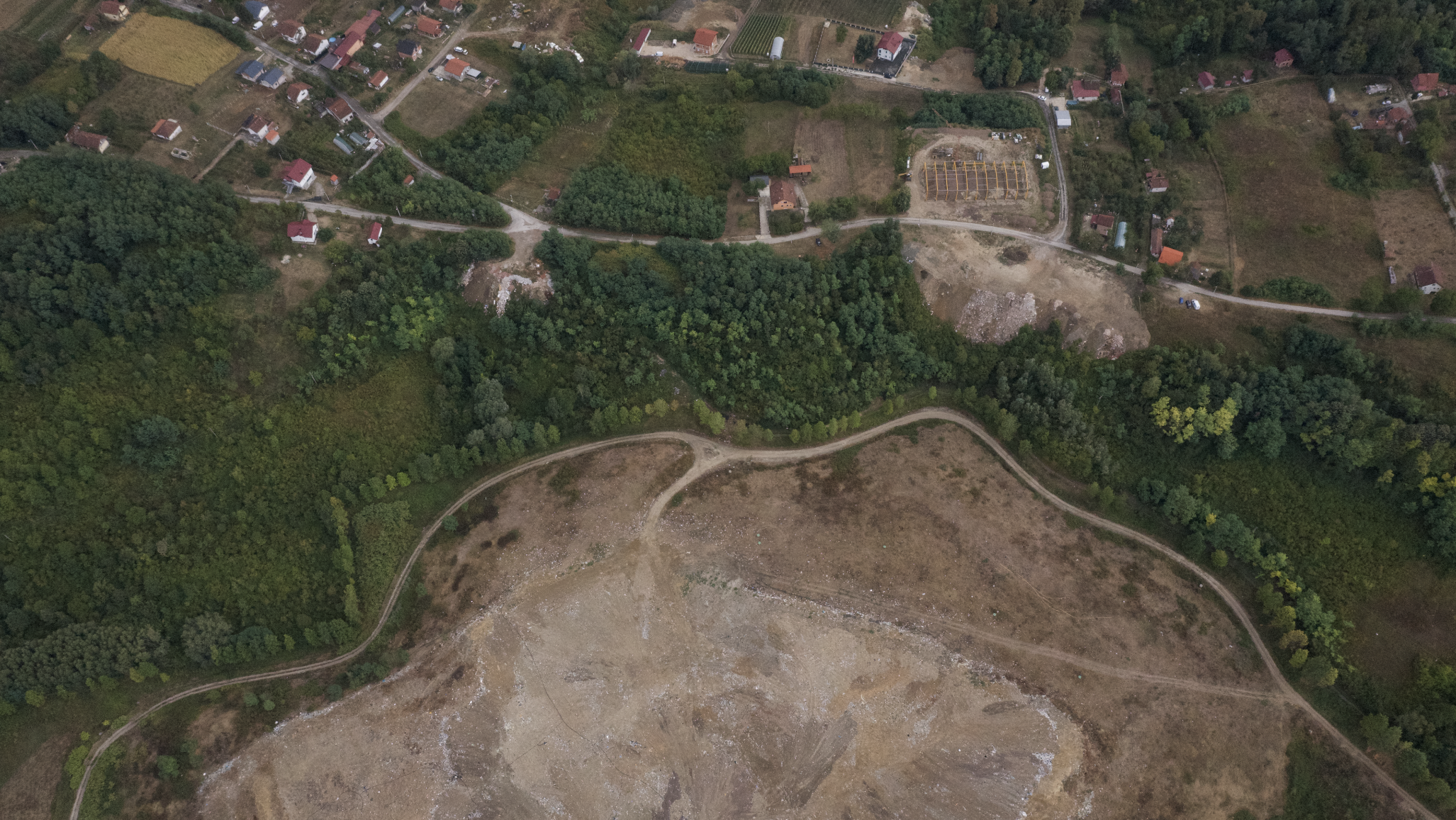
The proximity of the settlement and the growth of the landfill are worrying residents and activists. Photo: BIRN
Circular economy
Igor Kalaba, biodiversity and protected areas assistant at the Banja Luka-based Centre for Environment, said the public has the power to drive change.
“There is a whole array of problems that will only be solved the moment citizens realise they possess enormous potential to compel institutions to finally start doing their jobs,” he said.
What Bosnia needs, Kalaba argued, is a circular economy, starting with product design and packaging.
“We strive to have less waste by producing longer-lasting appliances, clothing, and other goods,” he said. “Design focuses on using recycled materials and creating products that are easy to repair. This enables further steps such as raw material recovery and various types of reuse, with recycling positioned near the very end, just before the landfill.”
Kalaba stressed that recycling “is not a magic wand”.
Depending on the type of raw material, “it too is a source of greenhouse gases”, he said. “Sometimes it requires money and energy, so other steps like repair, reuse, and the extraction and reinvigoration of available resources should be introduced first.”
It is essential to have separate waste collection before the broader community can even be expected to handle waste responsibly, Kalaba told BIRN, and argued that talking about civic awareness is unrealistic in a system where conscious action is not even made possible.
“The good thing is that, alongside protecting the environment and human health, the circular economy also creates new jobs, making it a win-win for society in every sense.”