


This post is also available in: Bosnian
For Selver Hrustic, all it took to join Russia’s war in Ukraine was to arrive at Moscow’s Sheremetyevo airport late on September 4 last year and tell the police of his intention.
“I already knew how the process goes,” he said. “That’s where you tell the police at the airport that you want to join the army.”
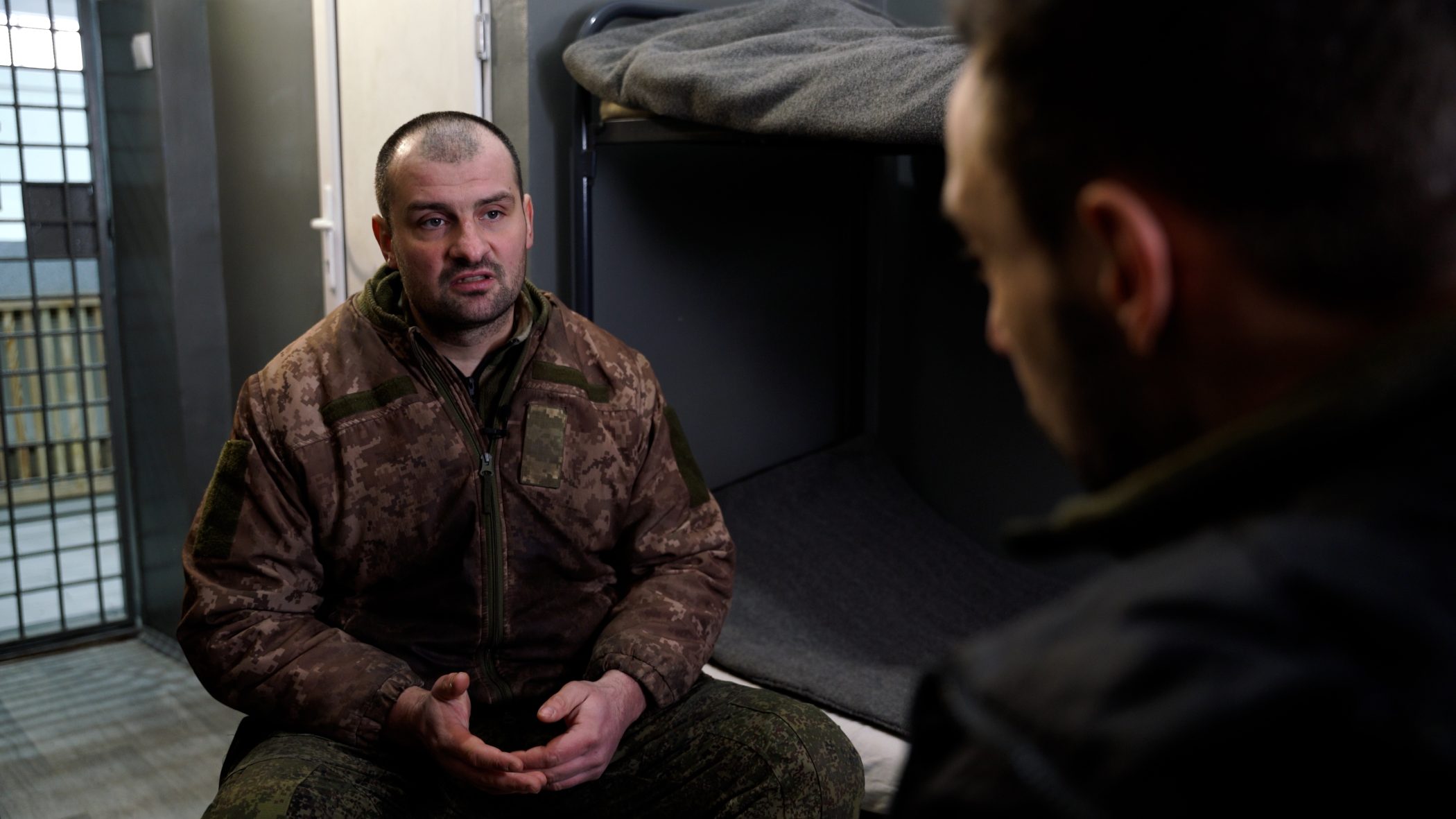
Speaking to BIRN in a prison cell in Ukraine, 35-year-old Hrustic, from Bosnia and Herzegovina, said he was taken to a police station then driven around the Russian capital in a civilian vehicle to pick up the documents he needed – a personal ID number, a bank account, a translation of his passport…
“It took me three days,” he said, and then he signed a preliminary contract and was taken to a military facility on the outskirts of Moscow, where the Russian intelligence service, FSB, ran checks on him. On September 18, Hrustic signed the full contract.
“And I’ve been a soldier ever since,” he said, dressed in military fatigues and sitting in a grey cell fitted with bunk beds.
Hrustic is believed to be the first Bosnian prisoner of war held in Ukraine after fighting on the side of Russian forces.
His journey began long before Sheremetyevo, however.
Seeking out recruiters
Hrustic first thought about joining the Russian army while waiting for asylum papers in Germany, saying the asylum process showed no sign of finishing.
He had been in trouble for drugs and violent offences in Germany and his native Bosnia, which he denied, and was looking for a fresh start; he also said he hoped that, if he fought in Ukraine, Russian authorities might help him with his legal issues in Germany.
Hrustic told BIRN he first went to Moscow in 2022, following Russia’s full-scale invasion of Ukraine in February that year. At that time, he contacted an organisation called Kosovo Front, which was known to recruit volunteers from the Balkans.
“I contacted a few, but they weren’t interested – a Bosnian, a Muslim… They already had a bad reputation in the media,” he said.
Then he said he came across Dejan Beric, a well-known Serbian mercenary fighting in Ukraine and who regularly posts video updates to his thousands of followers on Telegram and YouTube.
“I watched his videos, and when I was waiting for asylum in Germany, I contacted him,” said Hrustic.
“I saw that the asylum process wasn’t going anywhere. That’s how I contacted him. In 2023, he said that it was better for me not to come,” Hrustic said, claiming that the FSB initially believed he was working for NATO.
‘They send people to their deaths’
Hrustic described Beric as “concrete” but said he “didn’t promise anything special”.
“He said: ‘Everything goes according to the law, as determined by the Ministry of Defense’.”
Beric warned him, however, that the war was no game.
“He warned in particular that in the past few months the war was extremely dangerous,” Hrustic said.
Contacted via his Vkontakte profile, Beric told BIRN: “A captured man will say anything expected of him.”
Hrustic was sent to the front and fought near the town of Kupiansk-Vuzlovyi, where he was captured.
“In the beginning, everyone thinks it’s good and not hard,” he said, “but when they go to the front, the situation changes quickly. Ninety per cent of per cent of people want to return.”
The officers treat contract soldiers “badly”, he said.
“You could say that they differentiate between contract soldiers and the professional army; they don’t consider them to be their people at all.”
As for fighters from the Balkans, Hrustic said most seemed to be from Serbia and some from Bosnia.
“I spoke with a Serbian commander who has his own formation there,” he said. “I met a Serb at the training ground, but he has been in Moscow for many years, there in Russia, and he has a Russian passport, he is officially Russian.”
According to data from the State Prisoners of War Centre of Ukraine, there are some 200 men from the Balkans fighting on the side of Russia.
Hrustic said the Russian army looked on soldiers “as if they were not people”.
“They send people to their deaths. And they have no sympathy for it at all,” he said.
“And they always follow the same logic. They never change the plan. They always send us on the same route where the drones always kill us in the same place. And that’s how it goes for three months, you know. And they never want to change the plan.”