
No Licence, No Worries: How Bosnia’s Private Healthcare Clinics Flout the Rules

SEALED
BIRN delves inside the ‘wild west’ of private healthcare in Bosnia and Hercegovina, where even licencing rules are flouted.
The air-conditioned premises of the Medical Art Centre in Ljubuski, southern Bosnia and Herzegovina, provide a welcome respite from the sweltering Herzegovinian heat.
The reception is well-lit and spacious, the furniture new and white; soothing music plays over speakers, and friendly staff create an atmosphere of reassuring calm. Its website offers Botox treatments, dermal fillers, vitamin infusions, physiatry services, biopsies, tumour removal, ultrasound diagnostics, and breast reconstruction.
There’s just one problem.
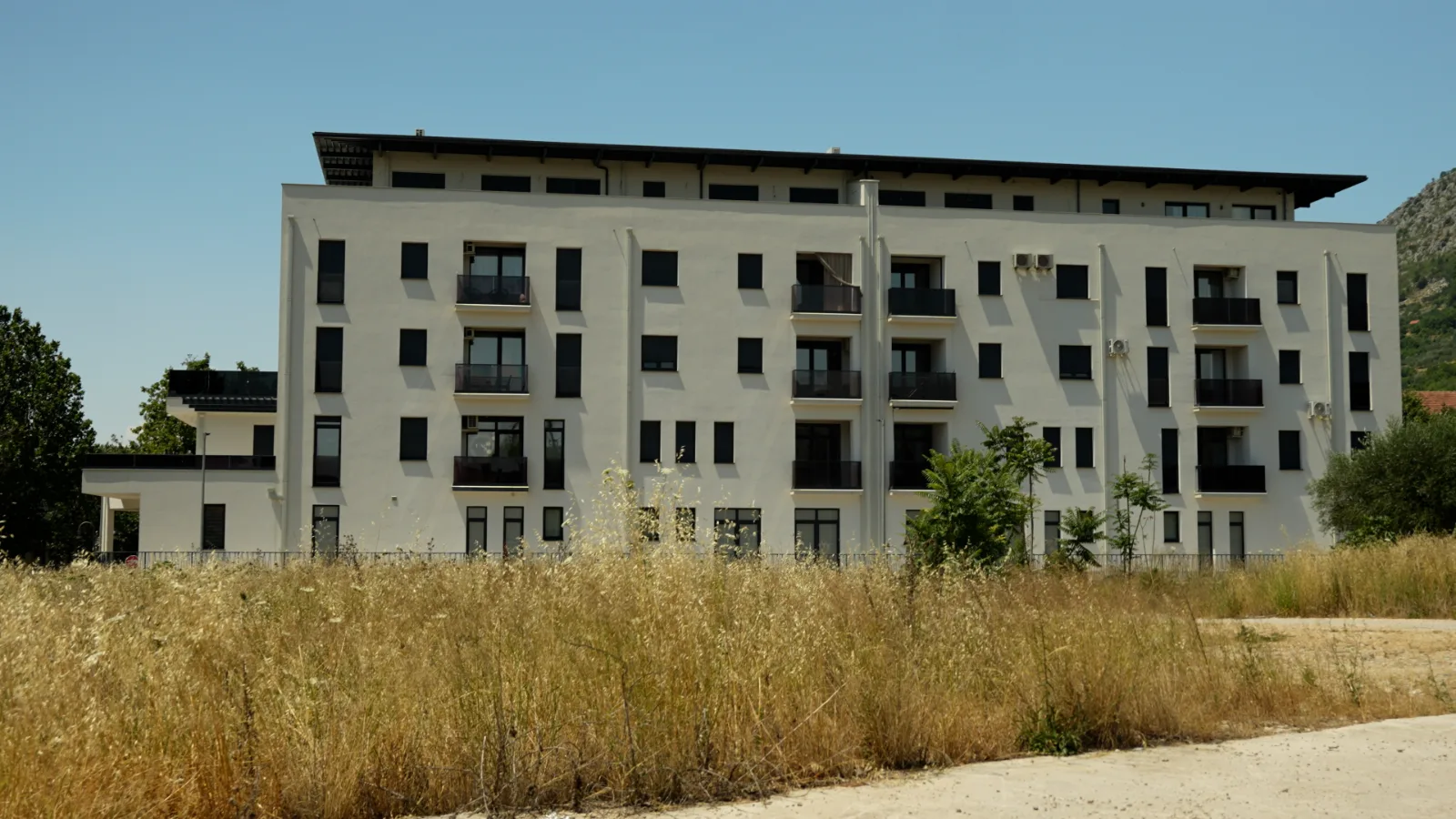
The centre, registered in 2024 as ‘Mart Polyclinic’, is prohibited from operating and employs a doctor who does not hold a valid licence to practice medicine in Bosnia.
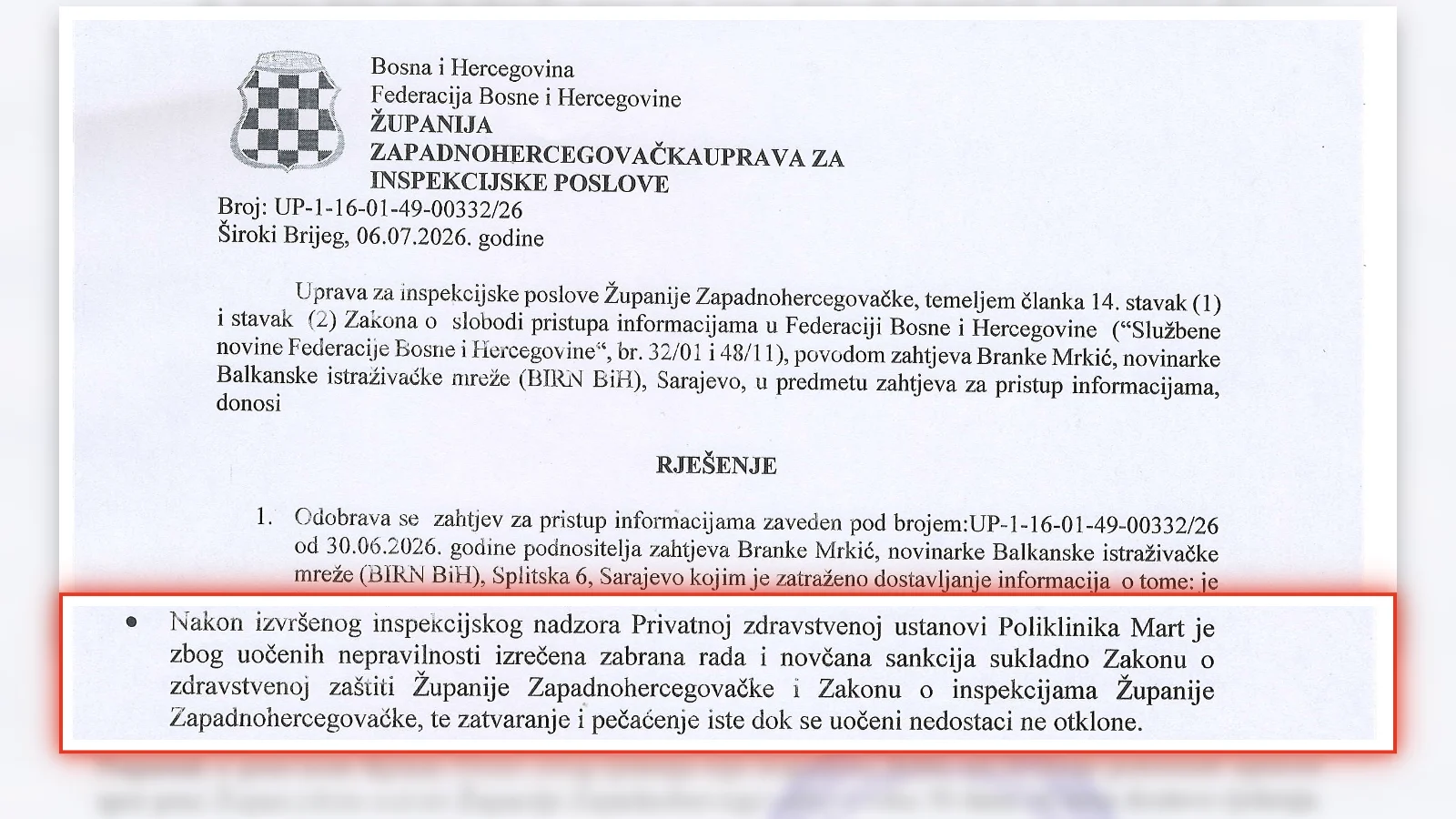
In written comments to BIRN, the West Herzegovina Canton Inspectorate said it had fined the polyclinic earlier this year for operating without being registered. Mart Polyclinic is closed and sealed, it said. Mart’s owner, Edina Hadzalic, also said the clinic was not currently operating and was “in the process of obtaining verification”.
Yet in late June, a BIRN reporter posing as a potential patient found it very much open and was able to schedule a consultation and a Botox treatment.
“Don’t worry about a thing,” the receptionist said, scheduling a final consultation with a doctor for the following week.
In several conversations, Hadzalic made a series of contradictory statements concerning the status of Mart, its staff, and its services, before consulting with a lawyer and telling BIRN: “We have decided not to make any official statements.”
Mart Polyclinic, however, is not the only cause for concern when it comes to private health clinics in Bosnia.
BIRN has identified at least 15 doctors who have worked – or are still working – in Bosnia without the necessary licences or official approval. The true number may be even higher since some of the 10 cantons in Bosnia’s Federation entity lack health inspectors.
“We’re currently seeing a flood of ‘consultants’ coming to private clinics,” said Rifat Rijad Zaid, president of the Medical Chamber of the Federation of Bosnia and Herzegovina and a specialist in neuropsychiatry. This represents a “legal grey area”, he told BIRN.
Operating out of “all sorts of premises”, these ‘consultants’ are “offering ‘free medical advice’ to people who come there seeking it,” he said.
“That is completely illegal. These foreign doctors are not allowed to come to Bosnia and Herzegovina in this way, nor are they allowed to offer or provide healthcare services, because they are not handing out cooking recipes – they are giving professional medical advice that can have real consequences," Zaid explained.

Under the law, a private polyclinic may operate only after it has been established as a legal entity, registered with the courts, and granted an operating licence by the relevant cantonal ministry of health.
A healthcare institution may begin providing services only after the ministry issues a final decision confirming that it meets all statutory requirements.
These include standards concerning the premises, employees, hygiene and sanitary measures, and medical equipment.
A clinic must also be included in the cantonal Register of Private Healthcare Institutions.
The West Herzegovina Canton health ministry told BIRN that Mart Polyclinic is not in its Register of Private Health Institutions. It said it was up to the Inspectorate to take any action. The Inspectorate said the clinic was closed and sealed.
According to business registry records, Mart Polyclinic reported total revenue of 5,000 Bosnian marks, roughly 2,500 euros, in 2024, and 1,700 marks in 2025.
Among the polyclinic’s staff is Zrinka Pribudic, identified as a specialist in plastic, reconstructive, and aesthetic surgery from the coastal city of Split in neighbouring Croatia. Business records also identify her as the director of the clinic.
However, according to the Medical Chamber of West Herzegovina Canton, Pribudic does not hold a licence to practice medicine in the canton where Ljubuski is located.
Hadzalic said Pribudic was “not currently providing” any services and that videos posted on the clinic’s social media accounts and showing Pribudic performing procedures were merely of a promotional nature.
“We’re promoting her in Bosnia and Herzegovina,” Hadzalic said. “We have to prepare the market so that, once we start operating, we’ll already have patients.” She insisted Pribudic has been issued a licence to practice by the “Medical Chamber of Bosnia and Hercegovina”, a body that does not exist.
Hadzalic said Pribudic did not wish to talk to the media and declined to provide a contact number or address for her.
Google reviews of the clinic specifically refer to Pribudic.
“Zrinka is truly an excellent doctor,” wrote one satisfied customer. “She explained everything to me in detail and prepared me for the part of the recovery that worried me the most. I'm really happy with the results. I highly recommend them!”
BIRN was unable to reach Pribudic via the University Hospital Centre Split, where she is employed, or the Matulic Polyclinic in Split, where she also works.
BIRN also found that Dr. Josip Bakovic, an abdominal surgeon from the Croatian capital, Zagreb, is not licenced by the Medical Chamber of the West Herzegovina Canton despite the fact the Futura Polyclinic in Siroki Brijeg said he treats its patients roughly once a month. Bakovic could not be reached for comment.
In 2022, the Vatanmed Polyclinic in the Bosnian capital, Sarajevo, hailed the arrival of “famous Turkish doctor” Ozcan Ciklatekerlio
“Let pain become a thing of the past with revolutionary therapy,” it wrote in a social media post, and invited patients to book appointments for radiofrequency ablation treatments intended to eliminate pain in the back, knees, and neck.
The Sarajevo Canton Medical Chamber, however, said Ciklatekerlio did not hold a licence to practice in Bosnia.
Contacted on WhatsApp, Ciklatekerlio said he held consultations with patients in Sarajevo “once or twice”.
“As far as I remember, the procedure for obtaining permission was complicated, and we did not want to deal with it because I was very busy at the time,” he said. However, by law, even consultations require approval from the cantonal health ministry, which told BIRN Ciklatekerlio was not on its list of approved consultants.
Vatanmed Polyclinic did not respond to requests for comment.
BIRN identified at least 10 Turkish doctors who visited the Sanasa Polyclinic in Sarajevo as consultants between early 2024 and June 2026 and were also not on the ministry’s list of doctors approved to perform consultancy work.
Such doctors are often brought to Bosnia by foreign healthcare providers registered in Bosnia, as a first step to Bosnian patients going abroad for treatment. In the case of the Sanasa Polyclinic, the Turkish doctors were brought over by the representative office of Liv Hospital in Bosnia and Herzegovina, a private Turkish hospital with branches in Sarajevo and Mostar.
Liv said it arranges “informational days” with doctors from Turkey in partnership with local hospitals and polyclinics in Bosnia.
“These local institutions, as licenced hosts, are responsible for the legal and administrative framework within their premises,” Liv Hospital told BIRN.
“Patient treatment takes place exclusively in Turkey: if, after the consultation, patients wish to undergo examination or treatment, they travel to our hospitals in the Republic of Turkey for that purpose.”
Sanasa Polyclinic did not respond to requests for comment.
Lejla Soylu, from the Bosnia office of the Medipol Global healthcare group, a major Turkish hospital group, said Medipol always complies with legal requirements in arranging communication between visiting doctors and patients.
Several times, said Soylu, the company had abandoned plans to bring doctors to Sarajevo, citing particularly complex paperwork in the canton.
“I will absolutely not do anything outside the law because I know what could happen to me,” Soylu told BIRN. “Tomorrow, there could be a complaint against me, and the hospital or the doctor could face consequences, so I am extremely careful. If I can arrange it, I do it through the proper paperwork; if I cannot, then I do not work here at all.”
All permits are obtained through the medical chambers, she said.
“They require certain documentation from the doctors, which we collect and submit. Later, the Minister of Health signs the approval, and that way we can proceed without problems. Before that, we obtain a work permit.”
Cantonal inspectorates should have designated health inspectors tasked with monitoring the compliance of private healthcare providers, but, according to BIRN’s findings, some don’t.
These include Canton 10, Posavina Canton and Central Bosnian Canton.
Canton 10 said it does not have a qualified health inspector, so the work is handled by the Federal Administration for Inspection Affairs, which told BIRN it had not received any complaints concerning the work of foreign doctors.

Posavina Canton confirmed it lacks a health inspector, while officials in Central Bosnia Canton said the designated health inspector had been on sick leave for the past 18 months.
Sead Sefic, head of the Federation of Bosnia and Herzegovina Prostate Cancer Patients Association and founder of the Vote for Life umbrella organisation of patient associations, blamed the phenomenon on a lack of local doctors.
“The shortage of doctors is one of the biggest problems we have identified in the healthcare system in Bosnia and Herzegovina,” he said. The danger, Sefic told BIRN, is that a patient will encounter “someone who may not be sufficiently qualified or educated”.
“The absence of a licence can be devastating for the patient.”
Alena Beširević contributed to this article